
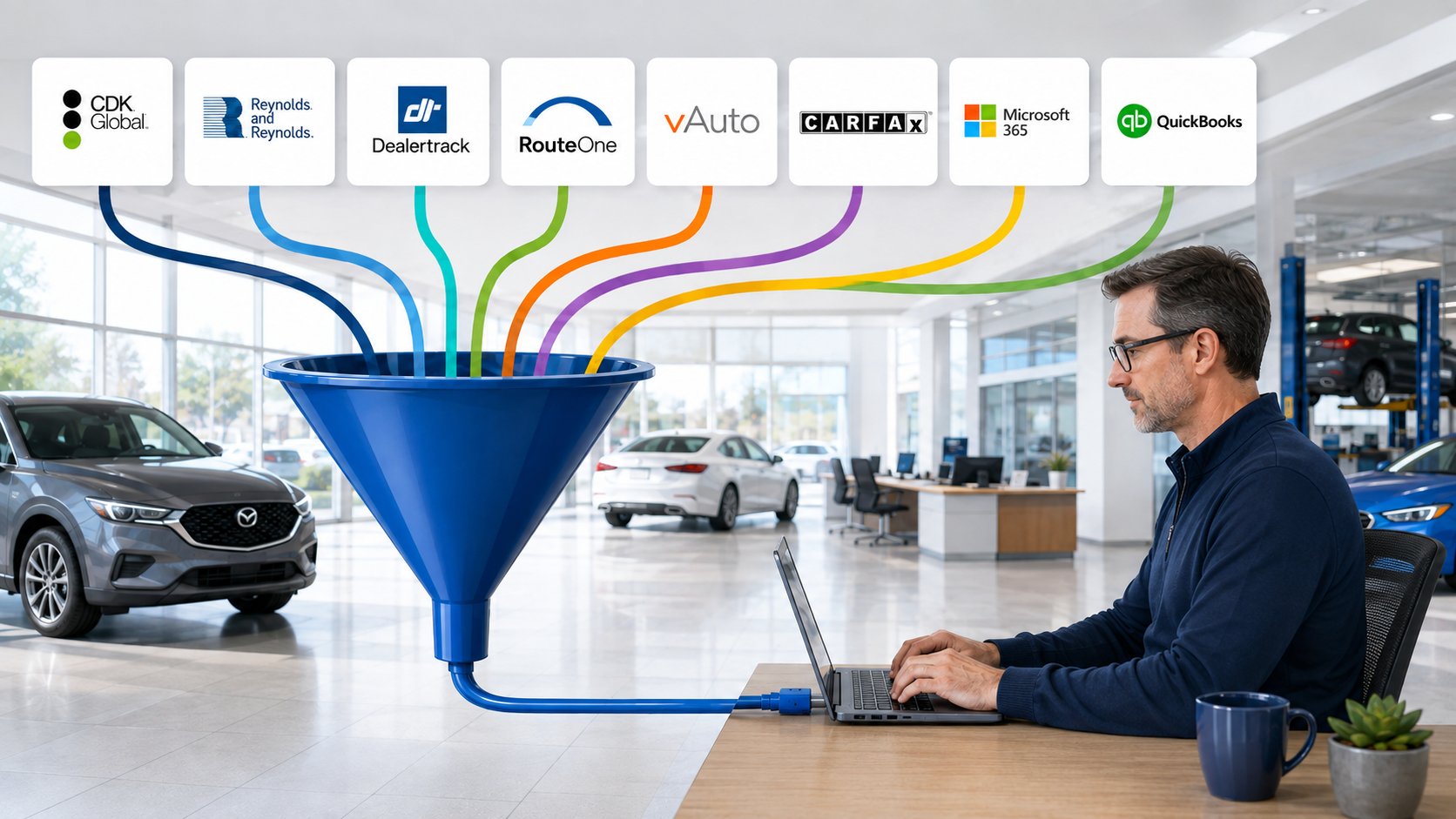
The dealer management system (DMS) is running slowly, so someone calls the DMS provider. They say the problem looks like the network. The internet company checks the connection and says everything looks fine. IT gets involved and suspects something with the application. Meanwhile, employees are still waiting and the General Manager or Controller is trying to figure out who needs to call whom next.
Most auto dealerships depend on a long list of technology vendors. That is normal. The problem begins when responsibility becomes unclear and dealership leadership ends up coordinating the troubleshooting.
When several dealership technology vendors are involved, one IT partner should take responsibility for coordinating the issue, gathering the right information, bringing in the appropriate vendors, and staying with the problem until there is a clear answer.
That does not mean the IT company can fix every DMS, CRM, phone, copier, payment, or internet problem itself. It means someone owns the process so the dealership does not have to.
For a busy dealership, that distinction can save a surprising amount of time.
Why Do Dealership Technology Vendors Keep Pointing Fingers?
Most vendor disputes are not really about vendors refusing to help. They happen because dealership systems overlap.
Consider a salesperson who cannot access the CRM.
The problem could be:
- The employee's computer
- Wi-Fi
- The local network
- Internet service
- DNS
- The employee's account
- The CRM application
- A cloud service used by the CRM
- A security setting
- An integration with another dealership system
Several companies may control pieces of that chain.
The CRM provider understands its software. The internet carrier understands its connection. The phone company understands its equipment. The DMS provider understands its platform. Your IT company understands the dealership's computers, accounts, network, security, and local environment.
Each vendor may be completely correct when it says, “Our system looks fine.”
The problem is that the dealership still isn't working.
That is why vendor coordination matters. Somebody needs to look beyond one piece of the problem and coordinate the companies responsible for the different pieces.
Dealerships Have More Technology Vendors Than Most People Realize
A dealership is not a typical small office with email, a few computers, and one business application.
Depending on the dealership, technology vendors may include:
- Dealer management system (DMS)
- Customer relationship management (CRM)
- Internet provider
- Phone provider
- OEM systems
- Lender and F&I platforms
- Service scheduling applications
- Parts systems
- Payment providers
- Website and digital retailing companies
- Copier and printer vendors
- Security camera companies
- Accounting and payroll systems
- Microsoft 365 or Google Workspace
- Cybersecurity vendors
- Backup providers
- Managed IT provider
A dealer group with several locations can have even more.
None of this is necessarily a problem. Specialized vendors are part of running a modern dealership.
What matters is whether leadership knows who is responsible for what - and who coordinates the problem when those responsibilities overlap.
The Dealer Principal or General Manager Shouldn't Be the Technology Referee
One of the clearest signs of a poor support process is when dealership leadership becomes the communication layer between vendors.
The conversation starts to sound like this:
“The DMS company says you need to call IT.”
Then:
“IT says we need to call the internet provider.”
Then:
“The internet provider says the circuit is fine.”
Then somebody at the dealership has to call IT again and explain what the internet provider said.
That is a lot of management time spent moving information between companies that could be speaking directly with one another.
A better process is for the dealership to have one primary technology contact.
When the problem is reported, that person or company investigates the environment it controls. If another vendor needs to become involved, the technology partner coordinates with that vendor, provides the technical information they need, follows the troubleshooting process, and keeps dealership leadership informed.
The dealership still owns the vendor relationships and ultimately makes business decisions. It just should not have to manage every troubleshooting conversation.
What Does Good Dealership Vendor Coordination Look Like?
Good vendor coordination is not complicated in theory. It requires clear ownership and consistent follow-through.
1. Start With One Point of Contact
Employees should know where to report a technology problem.
They should not have to diagnose whether the issue belongs to CDK, Reynolds and Reynolds, Dealertrack, Tekion, the phone provider, the ISP, Microsoft, or somebody else before asking for help.
They report the problem.
The support process determines where it belongs.
2. Gather Useful Information Before Escalating
Calling another vendor and saying, “It's not working,” usually does not move the issue very far.
A good IT partner gathers useful information first.
For example:
- Who is affected?
- Is it one employee or an entire department?
- Is one location affected or several?
- When did it begin?
- Can the system be reached from another computer?
- Is the internet connection working?
- Are other cloud applications available?
- Were any changes made recently?
- Are there useful logs or error messages?
- Has this happened before?
That allows the next vendor to start with more information instead of repeating the same basic troubleshooting.
3. Bring in the Right Vendor
If the evidence points toward the DMS, phone provider, ISP, copier vendor, or another company, the appropriate vendor should be involved.
The important part is that the dealership's IT partner does not disappear simply because another company now needs to participate.
Sometimes IT needs to provide network information. Sometimes the software vendor needs to test its application. Sometimes the ISP needs to examine the circuit while IT verifies what is happening inside the dealership.
The companies may need to work together.
4. Stay With the Issue
This may be the most important part.
A vendor saying, “Everything looks good on our side,” is useful information. It is not necessarily a resolution.
If employees still cannot work, the problem still exists.
Someone should continue narrowing down the cause until the issue is resolved or there is a clear understanding of what needs to happen next.
5. Keep the Dealership Updated
The General Manager or Controller usually does not need every technical detail.
They need useful answers:
- What is affected?
- Who is working on it?
- Which vendor is involved?
- Is there a workaround?
- What happens next?
- Is this a recurring problem?
- Is there something the dealership needs to decide?
Good communication reduces the temptation for leadership to start making separate calls simply because nobody knows what is happening.
Create a Simple Technology Vendor Map
One practical way to improve vendor coordination is to document the dealership's technology providers before something breaks.
A basic vendor map might look like this:
|
Service |
Primary Vendor |
Internal Owner |
First Support Contact |
|---|---|---|---|
|
DMS |
[DMS Provider] |
[Role] |
IT / DMS |
|
CRM |
[CRM Provider] |
[Role] |
IT |
|
Internet |
[ISP] |
IT |
IT |
|
Phones |
[Phone Provider] |
IT |
IT |
|
Copiers |
[Copier Vendor] |
[Role] |
IT / Vendor |
|
Microsoft 365 |
[Provider] |
IT |
IT |
|
Security Cameras |
[Vendor] |
[Role] |
IT / Vendor |
|
Payment Systems |
[Provider] |
[Role] |
Vendor / IT |
The exact structure is less important than having the information available.
For each important technology relationship, the dealership should know:
- What the vendor provides
- Who manages the relationship
- How support is contacted
- What systems the vendor can access
- Who approves changes
- Who should coordinate problems involving multiple vendors
That last question is the one dealerships often discover they never answered.
Recurring Problems Need a Different Conversation
A one-time outage happens.
A printer fails. A cloud service has an issue. An ISP experiences an outage. A vendor releases an update that creates an unexpected problem.
Those situations are frustrating, but they are part of operating a technology-dependent business.
A problem that keeps coming back is different.
If the same Wi-Fi issue happens every few weeks, the same application disconnects repeatedly, or employees keep losing access to the same system, repeatedly restarting equipment is not a long-term solution.
Someone should ask: Why does this keep happening?
That may require looking across vendor boundaries.
A software vendor may see application timeouts. IT may see network interruptions. The internet provider may see brief circuit instability. Separately, none of those observations tells the whole story.
This is where an IT provider adds value by looking for the underlying cause rather than simply closing the ticket once the immediate symptom disappears.
A dealership should not have to solve the same problem over and over.
Multi-Location Dealerships Need Even Clearer Vendor Ownership
Vendor coordination becomes more important as dealerships add rooftops.
Location A may have one internet carrier while Location B has another. An acquired dealership may still use a different phone provider. Different franchises may depend on different OEM systems. Contracts may renew at different times.
Without central coordination, each location can develop its own vendor relationships and support habits.
Eventually, leadership may not have an easy answer to questions such as:
- Which company provides internet at this location?
- Who manages this phone system?
- When does this contract renew?
- Does this vendor have remote access?
- Who opens support cases?
- Has this problem happened at another rooftop?
- Who is responsible for coordinating a multi-location outage?
This is one reason IT standardization across multiple dealership locations becomes more valuable as a dealer group grows.
The goal is not necessarily to have the same vendor everywhere. It is to have the same process for managing them.
Who Should Own the Problem?
The answer depends on what failed, but the dealership should have one accountable technology partner coordinating the process.
That does not mean IT accepts responsibility for another company's product.
If the DMS provider has a platform outage, the DMS provider still has to fix its platform. If the ISP has a circuit failure, the carrier still has to restore the connection. If a copier needs a hardware repair, the copier company may need to send a technician.
The IT provider's job is different.
A good dealership IT partner should be able to:
- Understand the dealership's overall environment
- Investigate the parts it controls
- Determine which other vendors need to participate
- Provide those vendors with useful technical information
- Coordinate troubleshooting when systems overlap
- Translate technical updates into understandable business information
- Keep the issue moving
- Document what happened
- Look for patterns when the same problem returns
That is what taking ownership means.
It is not claiming that every technology problem belongs to IT. It is making sure the dealership is not left alone trying to figure out who should handle it.
How Can You Tell Whether Your Current Vendor Coordination Process Is Working?
A few practical questions can tell you quite a bit.
Ask:
- Do employees know who to call first?
- Does your IT provider contact other technology vendors when necessary?
- Does the General Manager or Controller regularly have to relay messages between vendors?
- Do vendors have the information they need when a case is escalated?
- Is there a documented list of important vendors?
- Do you know which vendors have remote access?
- Are recurring problems tracked and investigated?
- Can leadership get a clear status update without calling three companies?
- Does someone stay with an issue until it is actually resolved?
If those questions are difficult to answer, the dealership may not have a technology problem as much as it has an ownership problem.
What Should You Do When Vendors Are Pointing Fingers Right Now?
If employees are already waiting while several vendors disagree, focus on getting everyone working from the same information.
First, identify exactly what is failing and who is affected. Avoid broad statements such as “the DMS is down” until you know whether the entire system is unavailable or several employees simply cannot reach it.
Next, establish one person or IT provider as the coordinator. Give that person the case numbers, vendor contacts, error messages, and any troubleshooting already completed.
Then allow the vendors to work directly with one another when technical information needs to be exchanged.
Leadership should stay informed, but it should not need to carry messages between support desks.
Once the immediate problem is resolved, review what happened. If the delay came from unclear responsibilities rather than the technical failure itself, fix the support process before the next incident.
Frequently Asked Questions About Dealership Technology Vendor Coordination
Who should an auto dealership call first when a technology system stops working?
Employees should generally have one established IT support contact rather than deciding which vendor caused the problem themselves.
The IT provider can investigate the dealership environment and involve the DMS, CRM, internet, phone, copier, software, or other vendor when necessary.
Should an IT company contact our DMS provider for us?
When the issue involves both the dealership's technology environment and the DMS, vendor coordination should normally be part of good IT support.
The IT provider may not be able to make account, contractual, or business decisions for the dealership, but it can often work directly with the DMS provider on technical troubleshooting.
Can an MSP support CDK, Reynolds and Reynolds, Dealertrack, or Tekion?
An MSP generally does not replace the support provided by the DMS company.
Instead, the MSP supports the dealership's computers, network, internet connectivity, user environment, cybersecurity, and other technology while coordinating with the DMS provider when a problem crosses between those systems.
Why do IT vendors blame each other?
Often they are looking at different pieces of the same problem.
An application vendor may see its servers operating normally while an internet provider sees a healthy circuit and IT sees a network that appears available. Determining why the employee still cannot work may require those companies to compare information rather than troubleshooting independently.
Should a dealership keep a list of all technology vendors?
Yes.
At minimum, the dealership should know what each vendor provides, who owns the relationship, how to contact support, and who should coordinate issues involving more than one company.
Multi-location dealer groups should maintain this information centrally rather than relying on individual rooftop managers to remember it.
Who should manage technology vendors at a multi-location dealership?
Responsibilities can be divided, but someone should have overall visibility.
Dealership leadership may own the commercial relationships while an internal IT employee or managed IT provider coordinates technical support and troubleshooting across locations.
The important part is knowing who owns each responsibility before a problem occurs.
Your Dealership Shouldn't Have to Chase the Answer
The dealership technology environment is complicated because the business itself is complicated.
Sales, service, parts, finance, accounting, customer communication, phones, internet, DMS, CRM, OEM systems, and outside vendors all have to work together.
It is unrealistic to expect one company to control every part of that environment.
It is entirely reasonable, however, to expect someone to own the process when those parts stop working together.
That is the difference between having a collection of technology vendors and having an IT partner.
For Morris County and Northern New Jersey auto dealerships, Tech Marvel helps coordinate DMS, CRM, phone, internet, software, and other technology vendors so dealership leadership does not have to spend the day figuring out whose problem it is.
Stop chasing IT problems. Focus on your dealership.
If vendor finger-pointing or recurring technology problems are creating extra work for your team, schedule a free 20-minute Dealership IT Review. We can talk through your current vendors, recurring issues, and support process and help you identify where clearer ownership could make things easier.