
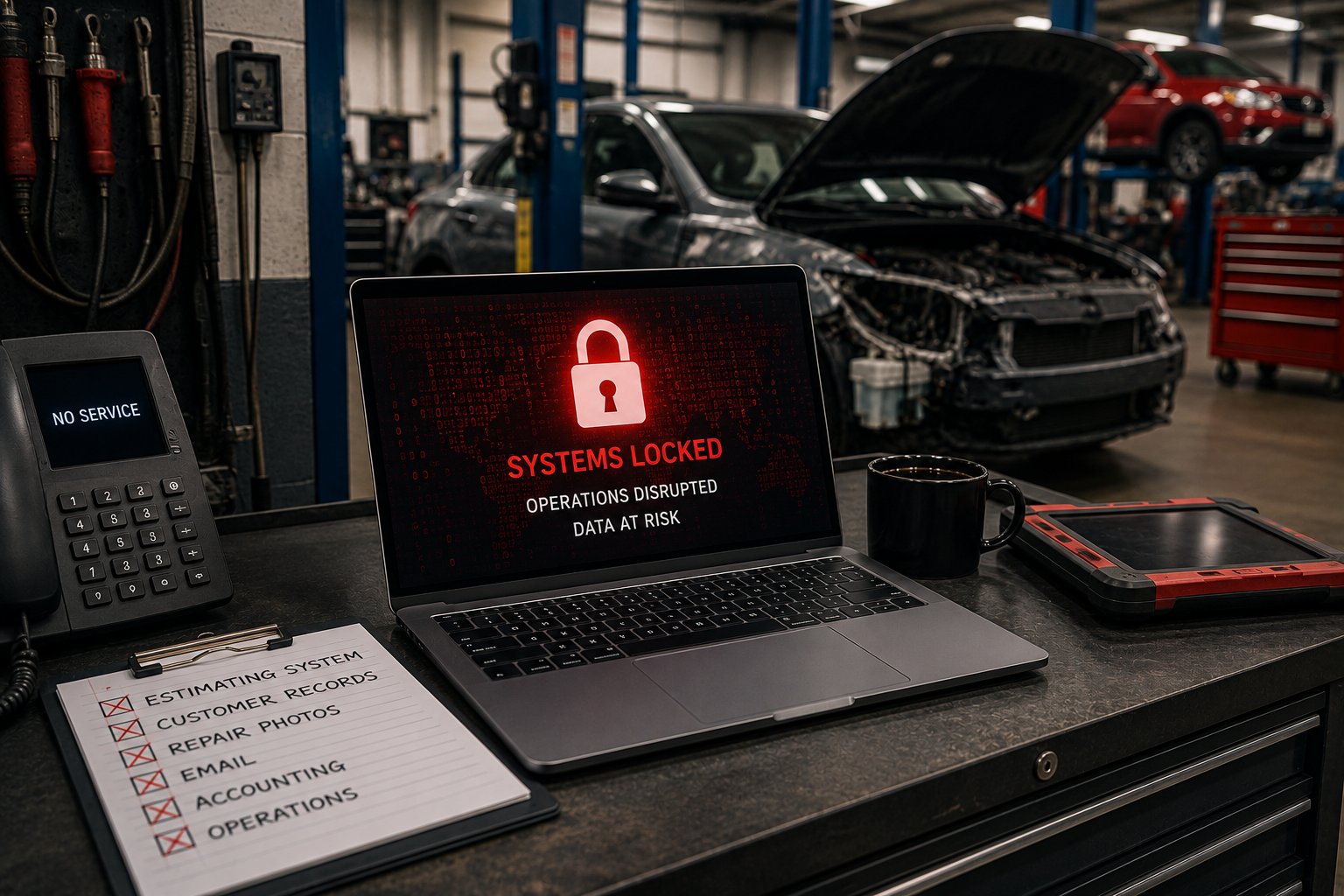
When most people think about a cyberattack, they picture hackers stealing information or locking computers with ransomware. While those threats are real, the biggest impact on a collision center is usually much more practical.
A cyberattack can bring everyday operations to a halt.
Your employees may lose access to customer records, repair photos, estimating software, email, or shared files. Communication with insurance companies and vendors can be interrupted. Customers may not receive updates about their vehicles, and work that was scheduled for the day can quickly fall behind.
That's why cybersecurity isn't just an IT issue. It's a business continuity issue.
The goal isn't to eliminate every possible threat. No business can guarantee that. The goal is to reduce risk, detect problems quickly, and keep your collision center operating when something unexpected happens.
Why Collision Centers Have Become Targets
Many collision center owners assume cybercriminals are only interested in large corporations with thousands of employees. In reality, businesses of every size are targeted every day.
That's because most cyberattacks aren't carefully planned against a specific company. They're automated.
Cybercriminals use software that continuously scans the internet looking for vulnerable computers, weak passwords, outdated software, or employees who click on convincing phishing emails. If your business appears to be an easy target, it may simply become the next opportunity.
Collision centers also manage a significant amount of important business information, including:
- Customer names, phone numbers, and email addresses
- Employee records
- Financial and accounting data
- Communications with insurance companies
- Vendor and supplier information
- Photos and repair documentation
Just as importantly, collision centers rely heavily on technology to keep business moving. Estimating systems, email, accounting software, shared files, and communication with customers and insurance partners all play an important role in daily operations.
When those systems become unavailable, productivity slows almost immediately. Employees can't access the information they need, customer communication is interrupted, and repairs may be delayed.
That's what makes businesses like yours attractive to cybercriminals. They're not necessarily interested in collision centers specifically. They're looking for organizations that depend on technology to operate because downtime creates pressure.
Whether the goal is stealing information, encrypting files, or gaining access to financial accounts, the end result is often the same: business disruption.
The good news is that becoming a target doesn't mean an attack is inevitable. Understanding how cybercriminals operate is the first step toward reducing your risk and making your collision center a much more difficult target.
The Most Common Ways Businesses Are Compromised
Cyberattacks rarely begin with a dramatic Hollywood-style hack. More often, they start with a simple mistake, an overlooked vulnerability, or a stolen password.
Understanding the most common entry points can help your collision center reduce risk and better protect its daily operations.
Phishing Emails
Phishing remains one of the most common ways businesses are compromised.
These emails are designed to look legitimate, often appearing to come from a customer, vendor, shipping company, bank, or even a coworker. Their goal is to convince someone to click a malicious link, open an infected attachment, or enter login credentials into a fake website.
Even employees who are careful can be fooled by a convincing phishing email, which is why ongoing security awareness training is just as important as technical security tools.
Weak or Stolen Passwords
Passwords continue to be a common point of entry for cybercriminals.
Using the same password across multiple accounts, choosing passwords that are easy to guess, or failing to enable multi-factor authentication can make it much easier for attackers to gain access if credentials are exposed in a data breach.
Strong password practices, combined with multi-factor authentication, significantly reduce this risk.
Outdated Software
Software updates do more than introduce new features. They often fix security vulnerabilities that attackers already know how to exploit.
When computers, servers, firewalls, or business applications aren't updated regularly, they may leave the door open to known security risks that have already been addressed by the software vendor.
Keeping systems up to date is one of the simplest and most effective ways to reduce your exposure.
Third-Party Vendors and Services
Most collision centers rely on a variety of technology partners, including software providers, cloud services, payment processors, and other vendors.
While these companies invest heavily in security, no organization is immune from cyber threats. A security incident involving one of your vendors can sometimes affect your business as well.
That's one reason it's important to work with trusted providers and have a plan for responding if one of your critical systems becomes unavailable.
The good news is that many cyberattacks are preventable. By combining good technology, employee awareness, and ongoing security management, collision centers can significantly reduce their risk while continuing to focus on serving customers.
What Every Collision Center Should Be Doing
While no business can eliminate cyber risk completely, there are several practical steps that can significantly reduce the likelihood of an attack disrupting your operations.
The goal isn't to implement every security tool available. It's to build multiple layers of protection that work together to reduce risk and help your collision center continue operating if something unexpected happens.
Enable Multi-Factor Authentication (MFA)
Passwords alone are no longer enough to protect business accounts.
Multi-factor authentication (MFA) adds an extra layer of security by requiring a second form of verification, such as a code sent to a mobile device or generated by an authentication app.
Even if a password is stolen, MFA can often prevent an attacker from accessing your systems.
Train Employees to Recognize Threats
Technology plays an important role in cybersecurity, but your employees are often the first line of defense.
Regular security awareness training helps employees recognize phishing emails, suspicious links, and other common tactics used by cybercriminals. The goal isn't to make everyone a cybersecurity expert. It's to help your team recognize when something doesn't seem right and know what to do next.
Keep Systems Updated
Software updates often include security patches that fix known vulnerabilities.
Keeping computers, servers, firewalls, and business applications up to date helps reduce the chances that attackers can exploit weaknesses that have already been identified and corrected by the software vendor.
Regular patching is one of the simplest and most effective ways to improve your overall security.
Protect Every Device
Every computer, laptop, and server connected to your network should be protected with modern security software that's actively monitored.
Today's endpoint protection tools can detect suspicious behavior, isolate compromised devices, and help stop threats before they spread throughout your network.
Monitor Your Environment
Many cyber incidents don't happen all at once. Attackers may spend days or even weeks attempting to gain access before causing visible damage.
Continuous monitoring helps identify unusual activity, failed login attempts, or other warning signs so potential threats can be investigated before they become major business disruptions.
Maintain a Tested Backup and Recovery Plan
Even with strong security controls in place, no solution can prevent every incident.
That's why a reliable backup and disaster recovery strategy remains an essential part of your overall cybersecurity plan. If an attack does occur, having monitored backups and a tested recovery process can help your collision center recover more quickly and minimize downtime.
As we discussed in our previous article, backups only provide value if you know they can be restored when you need them.
Cybersecurity isn't about relying on a single solution. It's about combining people, processes, and technology to reduce risk and keep your business running, even when unexpected challenges arise.
Cybersecurity Is About Business Continuity
One of the biggest misconceptions about cybersecurity is that success means never experiencing a cyberattack.
The reality is that even organizations with strong security measures can become targets. New threats emerge every day, and cybercriminals are constantly looking for new ways to exploit vulnerabilities.
That's why an effective cybersecurity strategy isn't built around preventing every possible attack. Instead, it's about reducing risk, detecting suspicious activity early, limiting the impact of an incident, and recovering as quickly as possible if something does happen.
When we help businesses respond to cybersecurity incidents, the biggest challenge often isn't removing the threat itself.
It's restoring normal business operations.
Employees need access to their systems. Customer communication needs to resume. Critical business applications need to be verified, and owners need confidence that it's safe to continue operating.
The businesses that recover the fastest usually aren't the ones with the most expensive security tools.
They're the ones that planned ahead.
They've invested in employee security awareness training, multi-factor authentication, layered security, ongoing monitoring, and a tested backup and disaster recovery plan. When an incident occurs, they know what to do because they've already prepared for it.
The most effective cybersecurity strategies combine five key elements:
- Employee security awareness
- Strong identity protection with multi-factor authentication
- Secure and up-to-date systems
- Continuous monitoring and threat detection
- A tested backup and disaster recovery plan
Cybersecurity isn't about protecting computers. It's about protecting your collision center's ability to continue serving customers.
While no business can eliminate every cyber risk, every collision center can take meaningful steps to reduce the likelihood of an attack disrupting daily operations. The goal isn't to react when something goes wrong. It's to prepare before it happens.
When cybersecurity is approached as part of an overall business continuity strategy instead of just an IT issue, your collision center is better positioned to recover quickly, minimize downtime, and continue delivering the level of service your customers expect.
At Tech Marvel, we help collision centers build practical cybersecurity strategies that protect both their technology and their business operations. By combining proactive monitoring, layered security, employee education, and disaster recovery planning, we help our clients stay focused on repairing vehicles instead of responding to technology emergencies.
An unexpected cyberattack doesn't have to become a business-ending event. With the right strategy in place, your collision center can reduce risk, recover faster, and continue delivering the service your customers depend on.
Schedule Your Free Discovery Call
Call 862-201-5710 or schedule your free discovery call with Tech Marvel to learn how we can help protect your collision center from cyber threats.