Backups are easy to trust when nothing is going wrong.
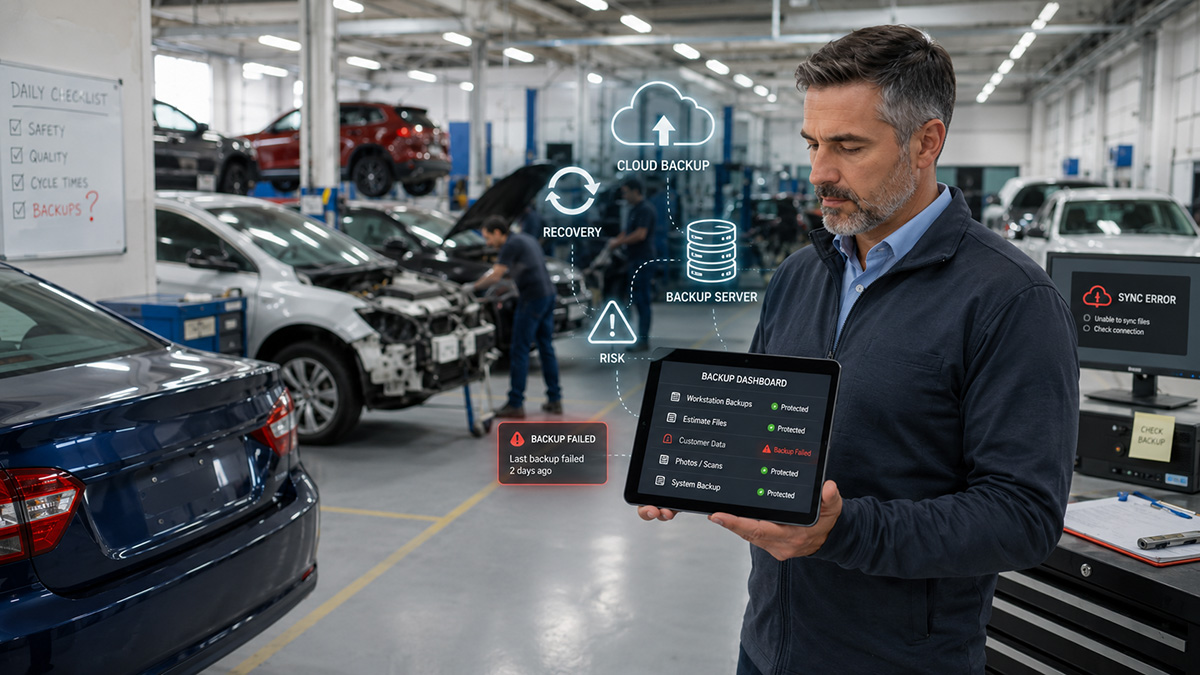
A report says the backup completed. Someone says the data is protected. Everything appears fine.
Then a server fails, an account is compromised, or an important file disappears.
At that point, the real question is not whether a backup exists.
It is whether your collision center can actually recover.
For collision centers, bad assumptions can affect estimates, supplements, customer records, insurance communication, phones, accounting, and the systems that keep vehicles moving through the shop.
Assumption #1: “We’re Backed Up”
Most collision centers believe their important information is being backed up somewhere.
That does not necessarily mean everything is protected.
A successful backup report does not tell you whether the right files were included, whether Microsoft 365 or Google Workspace data is protected separately, or whether the information can be restored quickly enough to keep the business operating.
A backup only has value when it can be recovered.
That means knowing whether you can restore a deleted estimate, recover an employee’s mailbox, replace a failed workstation, and regain access to accounting files, scanned documents, photos, and shared business data.
Until those steps have been tested, the backup is still an assumption.
Assumption #2: “Someone Would Tell Us if There Was a Problem”
Monitoring and backup notifications can warn that a job failed, storage is full, or a device has stopped checking in.
But an alert does not fix the problem.
Someone still has to receive it, understand it, investigate it, follow up, and confirm that protection has been restored.
A failed-backup notification sitting in an inbox does not protect the business.
Growing collision centers often rely on several technology vendors. One supports the estimating platform, another the internet, another the phones, and another the computers.
Each vendor may see only one part of the problem.
That is why the owner needs one accountable technology partner who sees the full environment and owns the response.
Assumption #3: “Our Team Knows What to Do”
Your staff may know how to restart a frozen computer or work around a slow application.
That is not the same as having a recovery plan.
Imagine several systems becoming unavailable on a busy Monday morning.
Estimators cannot access shared files.
Email is down.
Employees cannot reach an insurance portal.
The phones are unreliable.
One employee calls the software vendor. Another contacts the internet provider. A manager calls the person who originally installed the computers.
Everyone is trying to help.
Nobody is coordinating the recovery.
A practical plan should identify:
- Who reports the incident
- Who takes charge
- Which systems must return first
- How employees communicate if email or phones are unavailable
- Who contacts vendors
- Who updates management
The owner should receive clear updates.
The owner should not have to manage every call.
Assumption #4: “It Won’t Happen to Us”
Most disruptions do not begin with a dramatic warning.
They start with something ordinary.
A hard drive fails. An employee clicks a convincing phishing message. A file is accidentally deleted. A cloud account is compromised.
The better question is not whether your collision center will ever experience a technology problem.
It is how much the problem will affect the business when it does.
Can estimators keep working? Can customers still receive updates? Can employees reach insurance companies and vendors? Can another location help? Can critical data be restored?
The shops that recover fastest are usually not the ones that avoided every disruption.
They are the ones that decided what to do before the pressure started.
Multi-Location Shops Have More to Coordinate
The technology setup that worked for one location can become inconsistent as the company grows.
One shop may store files differently from another.
One location may have reliable backups while another depends on information stored locally on employee computers.
Important credentials may be known by only one person.
One location may receive backup alerts while another does not.
This does not mean the business handled growth poorly.
It often means the collision center grew faster than the technology process supporting it.
That is a positive milestone.
It is also the point when informal IT support may no longer provide enough consistency, visibility, or accountability across every location.
Replace Assumptions With a Tested Recovery Plan
A useful backup strategy should answer business questions, not just technical ones.
You should know what must be protected, which systems need to return first, how much work could be lost, how quickly employees could resume working, and who will coordinate the recovery.
Those answers should be documented and tested.
Tech Marvel helps growing collision centers in Morris County, Northern New Jersey, and throughout New Jersey understand what is protected, what is missing, how quickly their shops could recover, and who will own the response.
We look at your locations, computers, cloud accounts, estimating platforms, shared files, insurance communication, vendors, phones, internet, and other critical systems.
Then we build a practical plan around what your shops need to keep operating.
Schedule Your Free IT Roadmap Meeting.
Let’s replace backup assumptions with a recovery plan your collision centers can actually depend on.
Call 862-201-5710 or schedule your Free 20-Minute Dealership IT Review.