
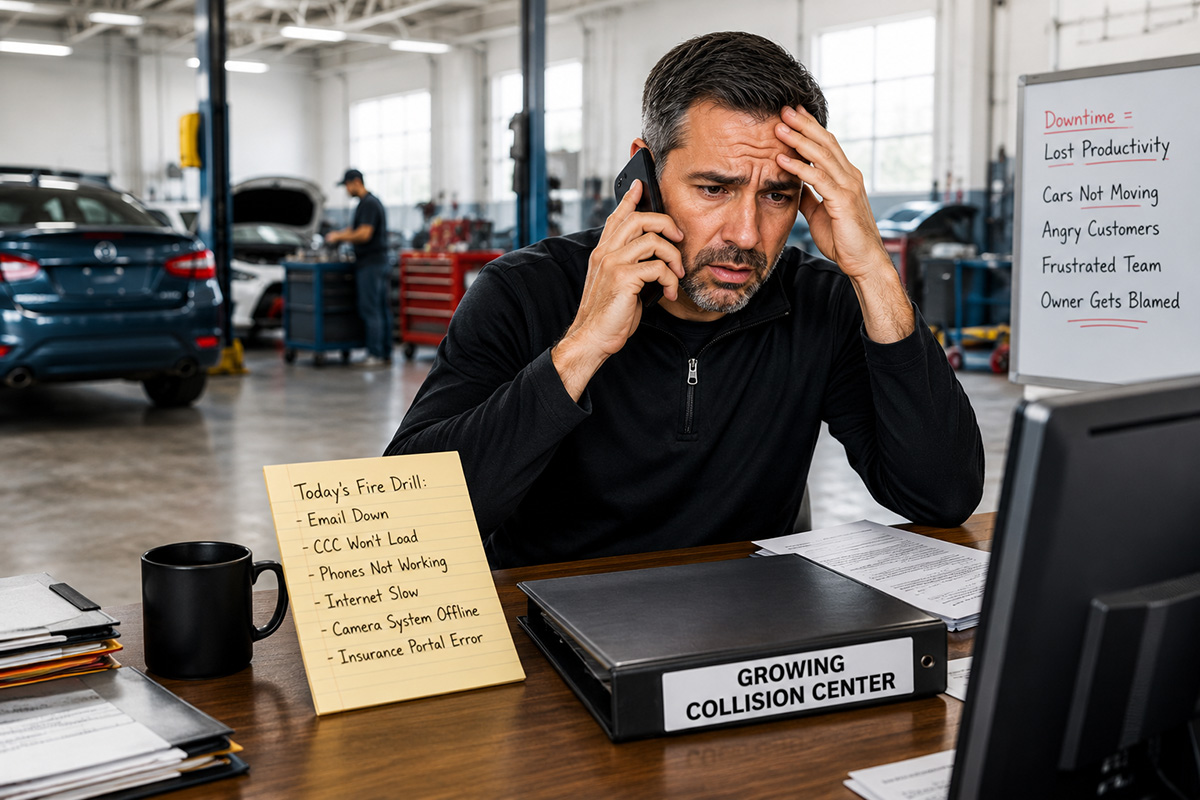
 Your collision center may have backups. But do you know what would happen if you actually needed them?
Fire drills are not designed to predict an emergency.
They are designed to make sure people know what to do before one happens.
A good drill answers practical questions: Who takes charge? What happens first? Where does the plan break down? Can everyone follow it when the pressure is on?
Your collision center’s technology recovery plan should be tested the same way.
Because the middle of an outage or cybersecurity incident is a terrible time to discover that a backup is incomplete, a password is missing, or nobody knows which system needs to come back first.
Having Backups Is Not the Same as Being Ready
Most collision center owners assume their important information is being backed up somewhere.
That may be true.
But a backup only helps when it can be restored quickly, completely, and in the right order.
Until that process has been tested, you are relying on assumptions.
Can you restore an important estimate or customer document?
Can an employee regain access to a damaged or replaced computer?
Are Microsoft 365 or Google Workspace email and files protected separately from the original cloud account?
If a server fails, how long will it take before your staff can work again?
Those questions become harder to answer when phones are ringing, customers want updates, and vehicles are no longer moving through the shop.
What an IT Outage Looks Like Inside a Collision Center
Technology problems do not stay contained to the office.
They spread across the entire operation.
Estimators may lose access to photos, estimates, supplements, or insurance portals.
Front-office employees may be unable to retrieve customer information or send repair updates.
Managers may lose visibility into scheduling, production, parts, or financial information.
Phones may stop working.
Email communication may stall.
Employees may begin calling different vendors for help, only to hear that the problem belongs to someone else.
Meanwhile, the owner becomes the escalation point.
That is the real cost of an untested recovery plan. It is not just a failed computer or missing file. It is the confusion and downtime created when nobody knows what happens next.
Which Systems Need to Come Back First?
Not every system has the same operational importance.
A recovery test should identify what your collision center needs first to keep functioning.
For many shops, the priority may be:
- Internet, firewall, and secure network access
- Employee accounts, email, and shared files
- Estimating and shop management systems
- Insurance portals and vendor communication
- Phones and customer communication tools
- Accounting, payroll, and administrative systems
- Security cameras and supporting technology
The correct order depends on your shops, systems, vendors, and workflow.
A single-location collision center may have one set of priorities. A growing operator with several locations may need separate plans for each shop, along with a companywide plan for shared systems.
The important part is deciding before the outage begins.
What a Real Recovery Drill Should Test
A recovery drill does not require shutting down the business.
It can begin with a few controlled tests.
Restore a deleted file and confirm that it opens correctly.
Recover a mailbox or cloud folder.
Test how quickly a replacement computer could be prepared for an estimator or manager.
Confirm that backup administrators can access the recovery system without relying on the same account that may have been compromised.
Document vendor contacts, account information, credentials, and escalation procedures.
Then time the recovery process instead of guessing.
You should also walk through a few realistic scenarios:
- A server fails on Monday morning.
- An employee account is compromised.
- Ransomware locks several computers.
For each scenario, determine who notices the problem, who makes the first call, which systems can still be used, how employees will communicate, and who keeps leadership updated.
A useful drill reveals the unclear steps while the situation is still controlled.
Recovery Is More Than Restoring Data
A serious technology incident involves more than backups.
Your plan should also address communication, decision-making, security, and business continuity.
Employees need to know where to report suspicious activity and who is authorized to make decisions.
Managers need a reliable way to communicate if normal systems are unavailable.
Leadership needs clear updates about what is affected, what remains operational, and what happens next.
If a cyberattack is involved, the team may also need to preserve evidence, reset accounts, coordinate with insurance, contact legal counsel, or notify affected vendors.
The goal is not for the owner to personally manage every step.
The goal is to have a clear process and an accountable partner already in place.
Multi-Location Shops Have More to Coordinate
The technology approach that worked when you had one shop may not be enough after the business grows.
With multiple locations, there are more employees, devices, internet connections, vendors, and opportunities for systems to be configured differently.
One location may have reliable backups while another does not.
Critical information may be stored on an employee’s computer instead of in a protected shared system.
Vendor credentials may be known by only one person.
Nobody may have a complete picture of how the locations are connected.
This does not mean the business made a mistake.
It usually means the collision center grew faster than its IT process.
That is a positive milestone, but it is also the point when informal support may leave the owner carrying too much responsibility.
Do Not Let Vendors Run the Recovery
During an outage, each vendor may focus only on its own product.
The internet company checks the circuit.
The software provider checks the application.
The phone vendor checks the phones.
The computer technician checks the workstation.
Each one may be doing exactly what they are supposed to do, but nobody is coordinating the complete recovery.
Growing collision centers need one accountable technology partner who understands the full operation, sets priorities, communicates with vendors, and keeps the process moving.
The owner should receive clear updates.
The owner should not have to manage every call.
Test the Plan Before Your Shops Need It
Nobody schedules a fire drill because they expect a fire the next morning.
They do it because an emergency is the worst time to invent a plan.
A controlled recovery test can uncover missing files, incomplete backups, outdated documentation, unknown passwords, unrealistic recovery times, and systems that were never protected.
Finding one of those problems during a test may be inconvenient.
Finding it during a real outage can stop the shop.
Tech Marvel helps growing collision centers in Morris County, Northern New Jersey, and throughout New Jersey build practical recovery plans around the way their shops actually operate.
We look at your locations, employees, estimating platforms, insurance communication, cloud accounts, computers, vendors, phones, internet, and critical business systems.
Then we identify what needs to be protected, what should be restored first, how employees should respond, and who will own the recovery when something goes wrong.
Schedule Your Free IT Roadmap Meeting.
Let’s determine whether your collision centers are ready to recover before a real outage forces you to find out.
Call 862-201-5710 or schedule your Free 20-Minute Dealership IT Review.