Many collision center owners think an IT department exists to fix computers. In reality, that's only one small part of the job.
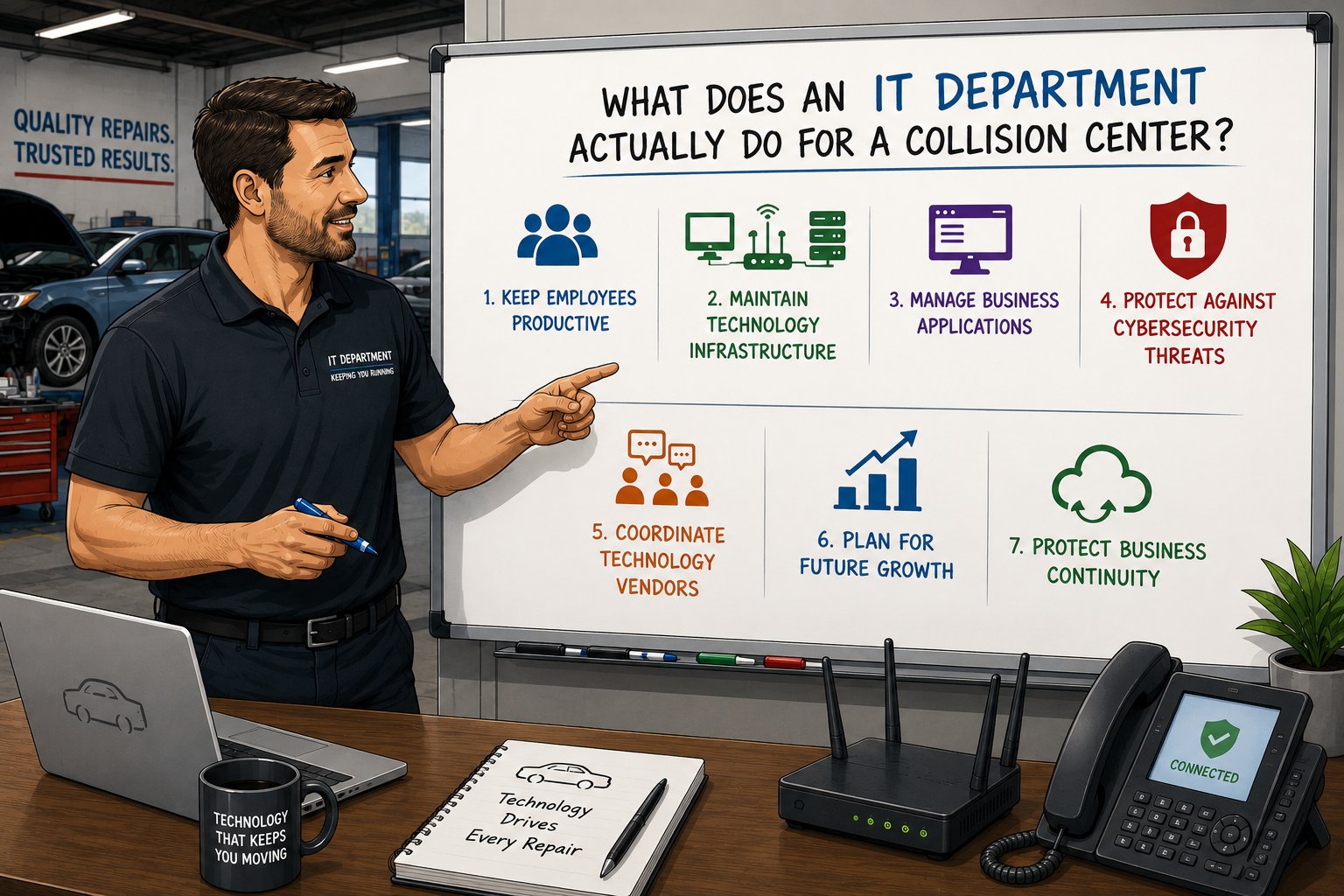
A modern IT department is responsible for keeping employees productive, maintaining the technology infrastructure, managing business applications, protecting the business from cybersecurity threats, coordinating technology vendors, planning for future growth, and ensuring the business can recover from unexpected disruptions.
Together, these responsibilities create a reliable technology foundation that allows employees to work efficiently, protects the business from unnecessary risk, and supports long-term growth.
In this guide, we'll explain the seven primary responsibilities of an IT department and why each one matters to your collision center.
|
IT Responsibility |
Why It Matters |
|---|---|
|
Keep Employees Productive |
Minimizes downtime and keeps work moving |
|
Maintain Technology Infrastructure |
Ensures computers, networks, and systems remain reliable |
|
Manage Business Applications |
Gives employees secure access to the tools they need |
|
Protect Against Cybersecurity Threats |
Reduces business risk and protects sensitive data |
|
Coordinate Technology Vendors |
Eliminates finger-pointing and saves management time |
|
Plan for Future Growth |
Aligns technology with business goals |
|
Protect Business Continuity |
Ensures the business can recover from unexpected disruptions |
An IT Department Maintains the Technology That Runs Your Business
Every collision center depends on a technology foundation that employees rarely think about until something stops working.
Computers, Wi-Fi, internet service, network equipment, servers, cloud platforms, and firewalls all work together to support your daily operations. If any one of those components fails or performs poorly, employees lose time, customer service slows down, and repairs can be delayed.
Maintaining this technology infrastructure is one of an IT department's most important responsibilities.
For example, if the wireless network doesn't provide reliable coverage throughout the building, estimators may have trouble uploading vehicle photos or accessing repair information. If aging network equipment slows communication between systems, employees may experience delays opening applications or accessing shared files. Even something as simple as an outdated computer can reduce productivity if employees spend extra time waiting for software to load throughout the day.
An effective IT department doesn't wait for these problems to become emergencies. It continuously monitors the health and performance of the technology environment, installs updates, replaces aging hardware before it fails, and ensures every system is working together as expected.
Infrastructure management also becomes increasingly important as a collision center grows.
Adding new employees, opening additional locations, or adopting new business applications all place greater demands on your technology. Without standardized equipment and a well-designed network, each expansion introduces additional complexity that makes the environment more difficult to support.
That's why high-performing collision centers treat their technology infrastructure like any other critical business asset. Just as repair equipment requires regular maintenance and eventual replacement, computers, network equipment, and supporting systems need ongoing attention to remain reliable and secure.
A well-maintained technology infrastructure doesn't just reduce downtime. It creates a stable foundation that allows employees to work efficiently today while supporting the future growth of the business.
An IT Department Manages the Software Your Team Uses Every Day
Computers and networks are only part of the technology your employees depend on. Every day, your team relies on a growing number of business applications to communicate, estimate repairs, manage customers, process invoices, and keep work moving through the shop.
An IT department is responsible for ensuring those applications remain available, secure, and properly configured.
For most collision centers, that includes Microsoft 365, email, collaboration tools, accounting software, estimating platforms like CCC ONE, document storage, and other cloud-based business applications. While the software itself may be supported by its vendor, someone still needs to manage user accounts, configure permissions, troubleshoot login issues, maintain licensing, and make sure employees can access the tools they need.
For example, when a new estimator joins your team, an IT department doesn't simply provide a computer. It creates user accounts, configures Microsoft 365, grants access to the appropriate applications, applies security policies, and verifies that the employee can access the systems required to perform their job.
The same process happens in reverse when an employee leaves the organization. Accounts should be disabled promptly, access to business applications removed, company data secured, and licenses reassigned where appropriate. These routine tasks help protect sensitive business information while ensuring employees have the right level of access to perform their responsibilities.
Managing business applications also means helping those systems work together. As collision centers adopt more cloud-based software, integrations between applications become increasingly important. An IT department works with software vendors to resolve issues, coordinate updates, and minimize disruptions when changes occur.
Employees shouldn't have to think about whether their applications are working correctly. They should simply be able to sign in, access the information they need, and get to work.
A well-managed application environment reduces frustration, improves productivity, and helps ensure technology supports the business instead of slowing it down.
An IT Department Protects Your Business from Cybersecurity Threats
Every collision center faces cybersecurity risks, regardless of its size. Phishing emails, ransomware, stolen passwords, and unauthorized access are no longer problems that only affect large corporations. They have become everyday business risks that can interrupt operations, expose sensitive information, and damage customer trust.
One of an IT department's most important responsibilities is reducing those risks before they become business problems.
That responsibility extends well beyond installing antivirus software.
A modern IT department manages multiple layers of protection, including endpoint security, email filtering, multi-factor authentication (MFA), software updates, security monitoring, user access controls, and employee security awareness. Each layer helps reduce the likelihood that a single mistake or vulnerability will disrupt the business.
For example, if an employee accidentally clicks a phishing email, email security may block the message before it reaches the inbox. If a malicious file is downloaded, endpoint protection may prevent it from executing. If an attacker obtains an employee's password, multi-factor authentication can help prevent unauthorized access to Microsoft 365 and other business applications.
Cybersecurity is also about controlling who has access to business information.
Employees should only have access to the systems and data they need to perform their jobs. When employees change roles or leave the company, those permissions should be reviewed and updated promptly. These routine administrative tasks are just as important as deploying security software because they help reduce unnecessary risk.
The goal of cybersecurity isn't to make a collision center impossible to attack. No business can eliminate risk entirely.
The goal is to make your business significantly more difficult to compromise while ensuring that, if an incident does occur, it can be detected quickly, contained effectively, and recovered from with minimal disruption.
A well-managed IT department treats cybersecurity as an ongoing business responsibility rather than a one-time project. As technology, threats, and business operations evolve, security measures must evolve with them.
An IT Department Coordinates Your Technology Vendors
Most collision centers rely on more technology vendors than they realize.
Your internet service comes from one company. Microsoft 365 is managed through another. CCC ONE has its own support team. Your phone system, copier, security cameras, internet provider, and hardware manufacturers may all have separate support organizations.
When everything is working properly, those relationships are almost invisible.
When something goes wrong, however, they can quickly become overwhelming.
Imagine your internet connection becomes unreliable. Employees can't access cloud applications, estimates are delayed, and customer communication slows down. Is the problem with your internet provider? Your firewall? Your network equipment? Microsoft 365? Or the application itself?
Each vendor may insist the problem lies somewhere else.
Without someone taking ownership, your office manager, general manager, or even the business owner often becomes the person coordinating multiple support calls, repeating the same information, and trying to determine who is actually responsible for resolving the issue.
An effective IT department eliminates that burden.
Instead of asking your leadership team to troubleshoot technology problems, the IT department becomes the single point of accountability. It works directly with internet providers, software vendors, hardware manufacturers, and other technology partners to diagnose issues, coordinate solutions, and ensure problems are resolved as quickly as possible.
Vendor management also extends beyond troubleshooting.
An IT department helps evaluate new technology, coordinates software implementations, manages hardware warranties, reviews licensing, and ensures technology vendors are working together instead of operating in isolation.
For a growing collision center, this coordination becomes increasingly valuable. As more technology is introduced into the business, so are more vendor relationships. Without clear ownership, managing those relationships can become a significant distraction for leadership.
Technology vendors should support your business, not consume your time.
One of the most valuable roles an IT department plays is serving as the central point of coordination, allowing owners and managers to focus on employees, customers, and operations instead of determining which vendor should be called next.
An IT Department Plans for the Future
Technology isn't something a collision center should only think about when equipment fails or a major project is underway. One of an IT department's most valuable responsibilities is helping the business plan ahead so technology supports future growth instead of becoming an obstacle.
As a collision center grows, its technology needs change.
Hiring additional employees requires new computers, user accounts, and software licenses. Expanding into a larger facility may require upgraded network infrastructure and wireless coverage. Opening a second location introduces new challenges around connectivity, security, standardization, and collaboration. Even adopting new software can require changes to hardware, licensing, or employee training.
Without a plan, these changes often become reactive. Businesses make emergency purchases, replace equipment only after it fails, and struggle to keep systems consistent across locations. Over time, this creates unnecessary complexity, higher support costs, and more downtime.
An IT department helps avoid those problems by developing a technology roadmap that aligns with the organization's business goals.
That roadmap may include hardware replacement schedules, budgeting for future investments, software evaluations, cybersecurity improvements, cloud migration planning, and technology standards that simplify future expansion. Rather than asking, "What do we need to fix today?" the conversation becomes, "What will our business need six months, one year, or three years from now?"
Planning also helps control costs.
Replacing computers and network equipment on a predictable schedule is often less expensive than responding to unexpected failures. Standardizing hardware and software reduces support complexity, while budgeting for future projects helps eliminate large, unplanned technology expenses.
Technology should never be the reason a collision center delays growth.
Whether you're adding employees, expanding to multiple locations, or acquiring another business, an IT department helps ensure your technology is ready to support those initiatives instead of slowing them down.
By treating technology as part of the overall business strategy, collision centers can make more informed decisions, reduce risk, and build a stronger foundation for long-term success.
An IT Department Protects Business Continuity
Even with reliable equipment, proactive maintenance, and strong cybersecurity, unexpected events can still occur. Hardware can fail, internet outages can happen, employees can accidentally delete important files, and cyberattacks can disrupt normal operations.
An IT department is responsible for making sure your collision center can recover quickly when those events happen.
Business continuity is about more than creating backups. It's about ensuring your business can continue operating with as little disruption as possible when technology problems occur.
That begins with a reliable backup strategy. Critical business data should be backed up regularly, stored securely, and tested to confirm it can actually be restored. A backup that has never been tested provides little value when the business depends on it most.
Recovery planning extends beyond data as well.
An IT department develops processes for responding to equipment failures, internet outages, cybersecurity incidents, and other unexpected disruptions. Employees know who to contact, systems can be restored in a predictable manner, and priorities are established so critical business functions return first.
Business continuity planning also considers how quickly operations need to recover.
For example, losing access to email for an hour may be inconvenient. Losing access to your estimating platform, customer information, or accounting system for several days could significantly impact production, customer communication, and revenue. An IT department helps determine which systems are most critical and develops recovery plans that reflect those priorities.
Preparing for these situations before they happen reduces uncertainty during an emergency. Instead of making decisions under pressure, the business follows a documented plan that has already been reviewed and tested.
The goal isn't simply to recover from a disruption. It's to restore normal operations as quickly as possible while minimizing the impact on employees, customers, and the business.
A well-prepared collision center understands that business continuity isn't an optional safeguard. It's an essential part of protecting the organization from unexpected events and maintaining confidence that operations can continue, even when technology doesn't go as planned.
Real Client Scenario: Building a Reliable Technology Foundation for Growth
A multi-location collision center was experiencing a variety of technology challenges that seemed unrelated at first. Employees regularly submitted support requests for slow computers and connectivity issues. Hardware replacements were handled only after equipment failed, user accounts were managed inconsistently, and leadership often found themselves coordinating between multiple technology vendors whenever a problem occurred.
As the business continued to grow, these challenges became more difficult to manage. Leadership wanted to focus on expanding operations, but technology issues were consuming more time and creating unnecessary frustration for employees.
Tech Marvel worked with the organization to standardize workstations, improve network reliability, implement proactive system monitoring, strengthen cybersecurity protections, streamline user account management, and establish a long-term technology roadmap. Instead of relying on reactive support, the business gained a technology partner responsible for maintaining the entire IT environment.
Today, employees spend less time dealing with technology issues, leadership no longer has to coordinate between multiple vendors, and technology planning is aligned with the company's long-term business goals. Rather than reacting to problems as they occur, the collision center has a stable, secure, and scalable technology foundation that supports continued growth.
Conclusion
An IT department does far more than answer help desk calls or repair broken computers.
Its responsibility is to keep employees productive, maintain the technology infrastructure, manage business applications, reduce cybersecurity risk, coordinate technology vendors, plan for future growth, and ensure the business can recover from unexpected disruptions.
When these responsibilities are managed proactively, technology becomes a competitive advantage instead of a source of frustration. Employees can work more efficiently, leadership can focus on running the business, and the organization is better prepared to grow with confidence.
If your collision center is spending more time reacting to technology problems than planning for the future, it may be time to evaluate whether your IT strategy is supporting your business as effectively as it should.
Call 862-201-5710 or schedule a free discovery call today to discuss how Tech Marvel can help your collision center build a more reliable, secure, and scalable technology foundation.