If your DMS, CRM, phones, internet, or email stopped working tomorrow morning, what would your dealership need back first?
More importantly, would everyone agree on the answer?
A technology interruption at an auto dealership can quickly affect several departments at once. Salespeople may lose access to customer information. Finance may have trouble reaching lender platforms. Service advisors may be waiting on systems or printers. Phones or internet issues can affect employees across the building.
The challenge is not preparing for every possible problem. It is making sure leadership knows what matters most, who owns the response, and what happens next when normal operations are interrupted.
September is National Preparedness Month, which makes it a useful time to have this conversation.
You do not need an all-day planning session to get started.
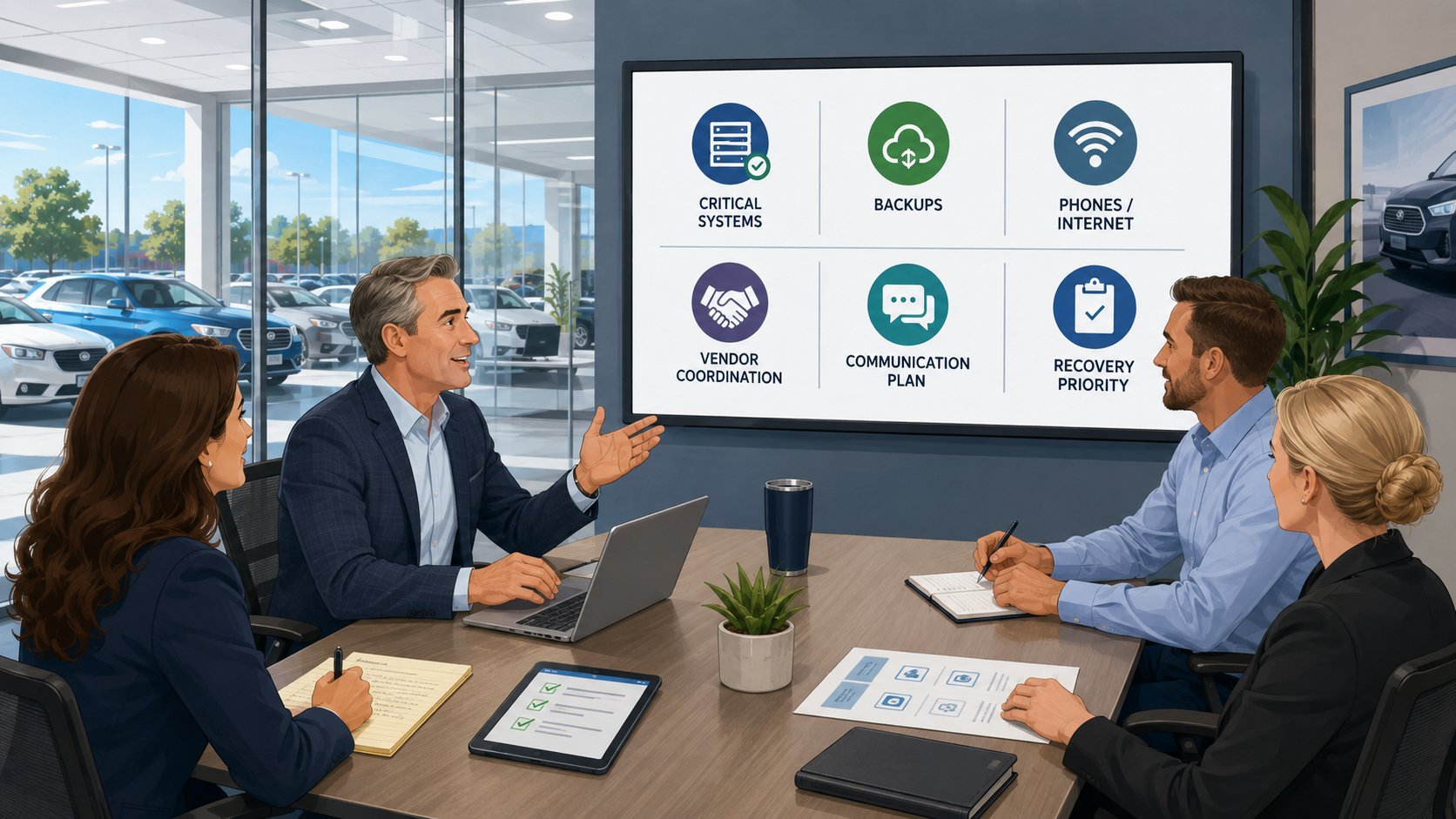
Give your Dealer Principal, General Manager, Controller, and whoever oversees your technology 15 minutes and work through these five questions.
1. If Our Dealership Went Down Tomorrow, What Would We Restore First?
Trying to restore everything at once usually isn't a useful recovery strategy.
Start by identifying the systems and functions your dealership cannot operate without for very long.
Depending on your operation, that might include your dealer management system (DMS), CRM, internet connection, phones, email, finance and lender systems, service applications, payment systems, or access to important dealership files.
The exact order will vary from dealership to dealership.
The important question is:
Which three systems or business functions would create the biggest operational problem if they were unavailable for several hours?
Leadership should be able to answer that before an outage happens.
Once those priorities are clear, your IT and recovery planning can be built around getting the dealership's most important functions operating first rather than treating every system as equally urgent.
2. Who Owns the Response When Several Vendors Are Involved?
This is particularly important for dealerships because one technology problem may involve several companies.
Your DMS provider may say the network is the problem. The internet provider may say its circuit is working. The phone company may point toward the firewall. Meanwhile, sales, service, finance, and accounting are waiting for someone to figure it out.
Someone needs to own the overall issue, even when that person or company does not own every individual system.
Leadership should know:
Who starts the response? Who communicates with employees? Who contacts the affected vendors? Who keeps track of what each vendor is saying? Who updates leadership? And who stays with the issue until there is a clear answer?
Good dealership IT support should reduce the amount of vendor coordination leadership has to handle - not create another vendor for the General Manager or Controller to chase.
3. How Would We Communicate If Our Normal Systems Were Unavailable?
Dealerships depend heavily on phones, email, internet access, and cloud systems.
When one of those systems goes down, communication often becomes part of the problem.
Ask your leadership team what would happen if employees could not access dealership email. How would managers communicate instructions? How would employees know whether systems were coming back online? How would customers reach the dealership if the phone system was unavailable?
For a dealer group with several locations, the question becomes even more important.
A simple backup communication process can make a significant difference. Leadership should know how key employees, vendors, and locations will stay in contact without relying entirely on the same systems that may be experiencing the outage.
It does not need to be complicated.
It does need to be documented.
4. What Is Our Biggest Technology Dependency?
Every dealership has a few systems, vendors, connections, or people that quietly support a large part of the operation.
Your biggest dependency could be your DMS.
It could be your internet connection.
It could be a cloud login used to access several applications.
It could be a vendor with remote access.
It might even be one employee who knows how an important process works when nobody else does.
Ask this question:
If one system, vendor, connection, or person suddenly became unavailable, which one would disrupt the largest part of the dealership?
Then look at what is protecting that dependency.
Is there a backup option? Is the process documented? Does someone else know how it works? Is there an escalation contact? Has the recovery process ever actually been tested?
You do not necessarily need to eliminate every dependency. You should at least know where they are.
5. If Something Went Down Tomorrow, What Would We Wish We Had Done Today?
This may be the most useful question in the entire meeting.
Would you wish you had tested your backups?
Documented your important vendors?
Written down recovery priorities?
Reviewed which vendors have remote access?
Created an emergency contact list?
Documented an important process that currently lives in one employee's head?
Confirmed who has authority to make decisions during an outage?
Most of these tasks are not difficult. They are simply easy to postpone while the dealership is busy selling vehicles, servicing customers, handling month-end, managing inventory, and dealing with normal day-to-day problems.
The best time to answer these questions is when nothing is broken.
Having Backups Is Not the Same as Having a Recovery Plan
Backups should certainly be part of this discussion, but leadership should go one step further.
The question isn't simply: "Do we have backups?"
It is: "If we needed those backups tomorrow, do we know what we could restore, how long recovery might take, and who would handle it?"
A backup that has never been reviewed or tested can create a false sense of confidence.
Recovery planning connects the technology to the actual dealership operation: what needs to come back, in what order, and what employees will do while systems are being restored.
Your IT Provider Should Help Answer These Questions
Dealership leadership should not need to become experts in networks, backups, cybersecurity, or disaster recovery.
Your IT provider should help you understand the business side of those issues.
That means helping identify critical systems, documenting important vendors, reviewing backup and recovery processes, establishing clear responsibilities, and making sure someone takes ownership when several technology companies are involved.
For Morris County and Northern New Jersey dealerships, having local support can also matter when an issue cannot be solved remotely and someone needs to be on-site.
The goal is not a complicated binder that nobody looks at.
It is a practical plan your dealership can actually use.
Put This 15-Minute Meeting on the Calendar
If your leadership team can clearly answer all five questions, that is a good sign.
If one or two questions create a long pause, that is useful too.
You have identified something worth reviewing before you're trying to figure it out during an outage.
At Tech Marvel, we help Morris County and Northern New Jersey auto dealerships get a clearer picture of their technology, backups, cybersecurity, vendors, and recurring IT problems. We focus on practical answers and clear ownership so dealership leaders can spend less time chasing technology problems and more time running the dealership.
Schedule Your Free 20-Minute Dealership IT Review
In 20 minutes, we'll talk through your locations, critical systems, vendors, recurring technology issues, backups, and current priorities.
You'll leave with a clearer picture of what may need attention and whether your current IT setup is keeping up with the dealership you're running today.
Call Tech Marvel at 862-201-5710 or schedule your free 20-minute dealership IT review.