
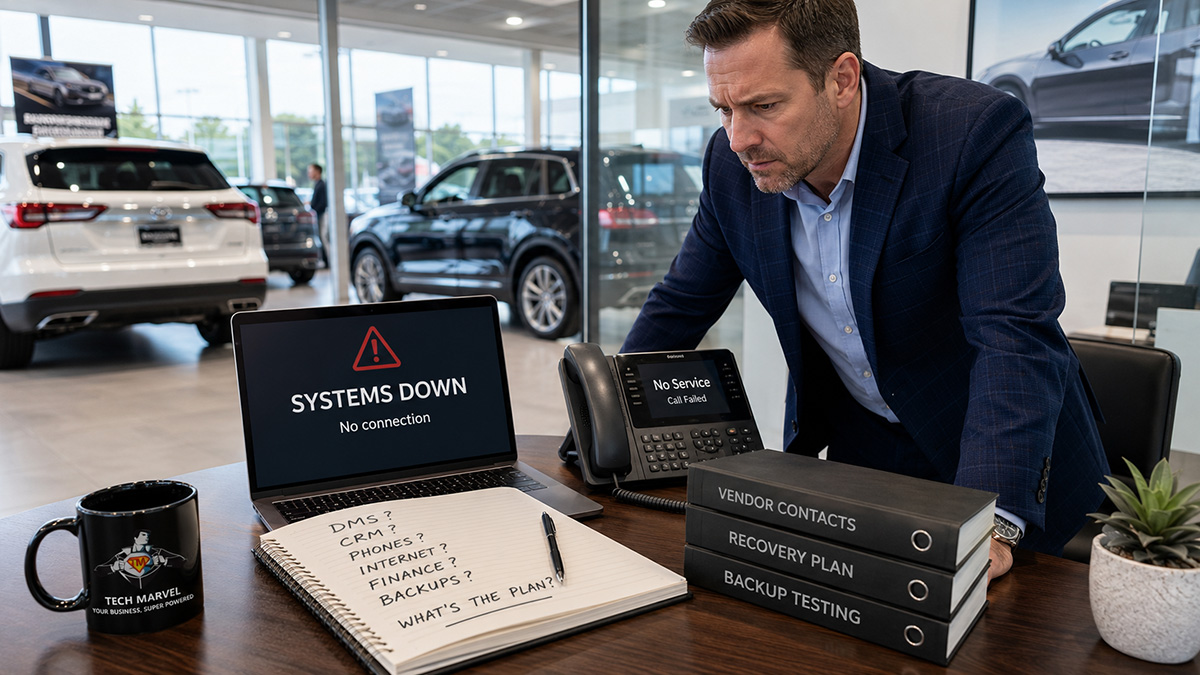
Your dealership may receive daily backup reports. Your IT provider may tell you everything is protected. Your leadership team may assume someone will know what to do if an important system becomes unavailable.
Those assumptions usually feel reasonable—until the dealership needs to recover something.
Then the questions begin.
Which information was actually backed up? How long will a recovery take? Who contacts the software vendors? What should come back first? Can sales, service, finance, and accounting keep working in the meantime?
A backup problem becomes expensive when the dealership has to answer those questions during the outage instead of before it.
Here are four assumptions dealership leaders should review before they are tested under pressure.
Assumption #1: “We Have Backups, So We’re Protected”
Most dealership leaders know that backups exist somewhere.
They may see successful reports, green checkmarks, or automated emails confirming that a backup completed. Those reports are useful, but they do not prove that every important system is included—or that the dealership can recover usable information from the backup.
A dealership may have information stored in several places. Files could be located on a local server, individual computers, Microsoft 365, Google Workspace, an accounting platform, shared cloud storage, or a locally installed application.
The dealership also relies on vendor-hosted systems such as its dealer management system, CRM, lender portals, OEM platforms, and service applications. Those systems may be managed by outside providers, which means the dealership needs to understand where its own responsibility ends and the vendor’s responsibility begins.
The practical question is not simply, “Do we have backups?”
It is: What is being protected, and has anyone successfully restored it?
A useful test might involve recovering an important folder, restoring a mailbox, opening a recovered accounting file, or testing a server recovery in a controlled environment. The purpose is not to disrupt the dealership. It is to confirm that the information is complete, readable, and available when employees need it.
The first time a backup is tested should never be the day the dealership depends on it.
Assumption #2: “Someone Will Tell Us if There’s a Problem”
Backup and monitoring systems can generate alerts when something fails.
The harder question is what happens after the alert arrives.
Who receives it? Does that person review it promptly? Is a support ticket opened automatically? Who investigates the cause? Does dealership leadership hear about the problem? How long can a backup fail before someone follows up?
An alert is only the beginning of the process.
For example, a backup may stop because a password changed, storage became full, a server was replaced, or an application was moved. The notification may be sent successfully, but if no one owns the follow-up, the failure can continue unnoticed.
This becomes more complicated when several companies are involved. The backup vendor may identify a connection problem. The IT provider may believe the software vendor changed something. The application vendor may say the issue belongs to the dealership’s network provider.
Meanwhile, everyone has received information, but no one is moving the problem toward a resolution.
Good backup management should define who reviews failures, how quickly they are investigated, when the dealership is notified, and who coordinates the vendors when responsibilities overlap.
The Dealer Principal, General Manager, or Controller should not have to discover an unresolved backup problem weeks later while answering a cyber insurance question or dealing with an outage.
Assumption #3: “Our Team Knows What to Do”
Most dealership employees know whom they normally call when something stops working.
That is not the same as having a recovery plan.
During a significant disruption, several departments may be affected at once. Sales may lose access to the CRM. Finance may be unable to reach lender platforms or documents. Service advisors may be waiting for customer information. Accounting may have payroll, reporting, or month-end work that cannot simply be postponed.
At the same time, leadership wants an update and several vendors may need to be contacted.
Without a documented process, employees tend to act independently. One person contacts the DMS provider. Another calls the internet company. Someone else opens a ticket with IT. Leadership receives several versions of the problem, and no one knows which company is coordinating the response.
A recovery plan does not need to become a hundred-page manual. It should provide enough direction to keep the dealership organized.
Leadership should know which systems matter most, who manages communication, where vendor contacts are stored, and which temporary procedures each department can use. Employees should also know how updates will be delivered if email or the phone system is unavailable.
For a multi-location dealer group, the plan should address whether another store can temporarily take over certain work. That may be possible, but shared accounts, internet services, phone platforms, cloud systems, or vendors can sometimes affect several locations at once.
Testing the process helps uncover those dependencies before leadership is trying to manage them in real time.
Assumption #4: “It Probably Won’t Happen to Us”
Dealership leaders have more immediate issues competing for their attention.
They are managing inventory, staffing, sales goals, service operations, customer experience, vendor relationships, and expenses. Backup testing can easily become something the dealership plans to address later.
But a disruption does not have to be dramatic to create a serious interruption.
An employee can accidentally delete information. A piece of hardware can stop working. A power or internet problem can interrupt access. A software change can affect a backup process. A compromised employee account can lead to data loss or wider security concerns.
The dealership does not need to predict every possible incident.
It needs to know how it will respond when an important system or piece of information becomes unavailable.
A practical starting point is to review what is protected, restore something meaningful, establish the recovery order, and document who owns the response. That exercise often reveals outdated vendor contacts, missing systems, untested backups, or responsibilities that were never assigned.
Finding those issues during a planned review is far less disruptive than finding them while employees and customers are waiting.
Backup Problems Often Begin With Unclear Ownership
After more than 30 years of working with business technology, we have found that recovery problems are not always caused by a complicated technical failure.
They are often caused by simpler issues.
A backup was never tested. An alert went to someone who no longer works there. A cloud application was added but never included in the backup plan. A vendor contact was outdated. Several companies were involved, but everyone assumed someone else was handling the problem.
Each issue may seem small on its own. Together, they can add hours or days to the recovery process.
That is why backup and disaster recovery for an auto dealership should include more than software. It should also include testing, documentation, communication, vendor coordination, and someone who stays with the issue until the dealership is moving again.
What Should Your Dealership Review?
A useful backup and recovery discussion should answer five questions:
- Which dealership systems and information are currently protected?
- When was the last successful recovery test?
- Which systems must return first for employees to work?
- Who coordinates the response when several vendors are involved?
- How will leadership and employees receive updates?
Uncertainty in any of these areas does not automatically mean the dealership has a bad backup system. The dealership may simply have outgrown the process that was created when it had fewer employees, fewer applications, or one location.
Your recovery process should match the dealership you are operating today.
Review Your Dealership’s Backup and Recovery Process
Tech Marvel helps Morris County and Northern New Jersey auto dealerships review their backups, test recovery processes, document priorities, and coordinate the vendors involved in keeping the dealership running.
During a free 20-minute dealership IT review, we can talk through your locations, critical systems, current backup process, vendor responsibilities, and any concerns that have not been fully addressed.
The goal is to help you understand what has been tested, what still depends on an assumption, and what your dealership should review next.
Call 862-201-5710 or schedule your Free 20-Minute Dealership IT Review.