
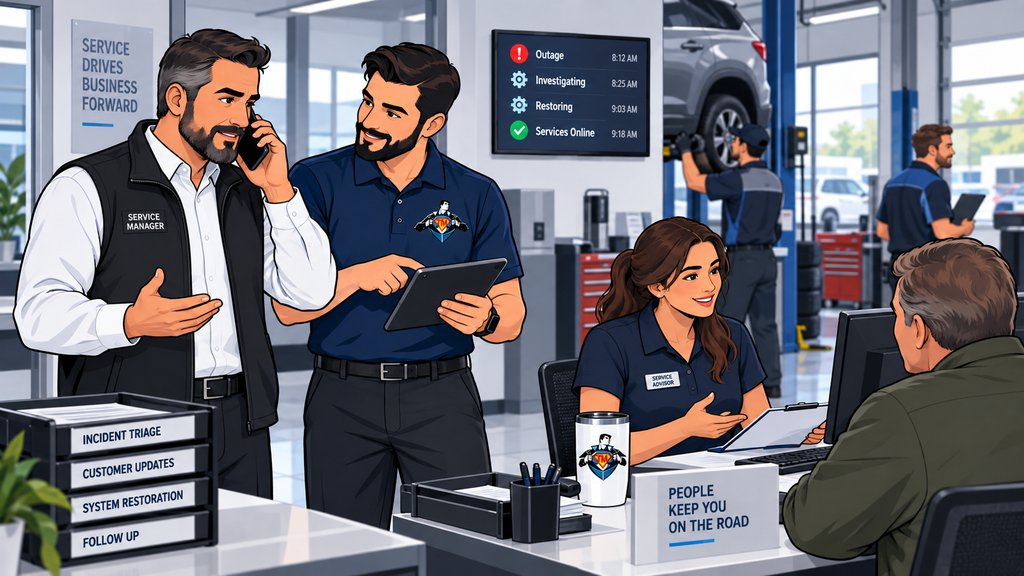
If one salesperson can't print, that employee needs help. If the internet, phones, or DMS is down across the dealership, you have a different problem. Sales, service, finance, parts, accounting, and management can all be waiting at once.
The first question is usually, 'How fast will this be fixed?' Of course it is. But no responsible IT provider can give the same resolution time for every outage before finding out whether the cause is a firewall, carrier, software vendor, power problem, damaged cable, cyber incident, or something nobody has seen yet.
The better question is what your IT provider should do immediately, and what you should expect while the cause is being worked.
When a dealership is down, its IT provider should acknowledge the incident quickly, confirm how much of the business is affected, assign someone to own the response, begin triage, and set a time for the next update. A dealership-wide outage should take priority over routine requests, even when the final resolution depends on an internet carrier, DMS provider, phone vendor, or on-site repair.
Response time and resolution time are not the same
Response time measures how quickly work begins; resolution time measures how long it takes to restore service or provide a safe workaround.
Response time is how long it takes the provider to recognize the request and start working. Resolution time is how long it takes to restore service or provide a safe workaround. A five-minute acknowledgement followed by two hours of silence doesn't help much, especially when one day of dealership downtime can carry real costs. A blanket promise to fix every issue within an hour isn't credible when the failed circuit or application belongs to another vendor.
A useful response gives the dealership evidence that the incident is active: the scope has been confirmed, the right technical person is involved, vendor escalation has started where needed, and leadership knows when it will hear more.
Priority should follow business impact
A dealership-wide outage should take priority over routine requests because several departments and customer workflows may be affected at once.
Ticket priority should reflect what the problem is doing to the dealership. The title of the person reporting it matters less than the number of people, departments, customers, and critical workflows affected.
Critical dealership outage
A full internet outage, unavailable DMS, broad phone failure, ransomware warning, or issue that stops several departments belongs at the top of the queue. The provider should establish an incident owner, gather the facts quickly, and coordinate every vendor needed to restore priority operations.
Major departmental interruption
A service department that cannot reach repair-order or scheduling systems may still represent a major business interruption even if the showroom is working. The same is true when finance cannot reach lender portals or accounting cannot complete a time-sensitive process.
Individual and routine requests
A single-user issue, new software request, password change, or planned equipment move still deserves a response, but it should not displace a dealership-wide outage. A clear priority system keeps routine work moving while protecting the incidents with the greatest operational impact.
What should happen during the first response
The first response should confirm the scope, assign an incident owner, begin triage, start vendor escalation, and set the next update time.
NIST's incident-response guidance treats preparation, detection, response, recovery, communication, and improvement as connected parts of an effective response capability.
- Confirm who is affected, which locations or departments are involved, and when the problem began.
- Identify what still works so the dealership can use a safe temporary process where possible.
- Check monitoring data, recent changes, power, internet status, network equipment, and known vendor outages.
- Assign one person to own the incident and coordinate the DMS, carrier, phone, copier, or other vendors involved.
- Give leadership a plain-English summary and a specific time for the next update, even if the cause is not yet confirmed.
- Document what restored service and what should change to reduce a repeat outage.
That last point is easy to miss. Once the phones come back or the repair-order screen loads again, everyone wants to move on. Take a few minutes first to record the cause, what restored service, where communication broke down, and what would prevent the same scramble next time.
What a dealership should ask about service levels
What does the promised time measure: acknowledgement, technician assignment, work beginning, a workaround, or full resolution?
A service-level agreement can be helpful, but the numbers need definitions. Ask whether the stated time means acknowledgement, technician assignment, remote work beginning, on-site arrival, workaround, or full resolution. Also ask which hours are covered, how emergency requests must be submitted, and what happens after hours.
- How are dealership-wide outages classified?
- Which channel should we use for a critical incident instead of sending a normal email?
- When will a technical person begin triage?
- How often will management receive updates?
- Who decides that on-site work is required?
- Who contacts and follows up with outside vendors?
- What is excluded from the response commitment?
- Will we receive a short review after a major or recurring outage?
What responsive support looks like at Tech Marvel
Responsive support combines priority-based triage, clear updates, remote resolution when possible, local escalation, and ownership across vendors.
Tech Marvel prioritizes support based on business impact. Most issues are resolved remotely within an hour, which often gets employees working again without waiting for a technician to drive to the dealership. That is an operating result, not a promise that every outage has the same cause or can be resolved on the same schedule.
When help desk and remote support aren't enough, local presence matters. A provider based in Morris County can move from remote diagnosis to on-site work without treating Northern New Jersey as a distant service territory. You also shouldn't have to call the DMS company, carrier, and phone vendor separately and relay messages among them. Our article about when dealership IT vendors blame each other explains why one accountable technology partner should drive the issue to resolution.
How your dealership can help IT move faster
Your dealership can speed triage by reporting the scope, recent changes, affected departments, and who can provide access to equipment.
Your employees shouldn't have to troubleshoot the network, but a little structure makes the first call much more useful. Report the scope, not only the symptom. 'The internet is down in sales, service, and finance at both buildings' tells us far more than 'my computer isn't working.' Mention a power event, construction work, equipment change, carrier visit, or odd message that appeared just before the outage.
Designate one dealership contact for management updates and another person who can provide access to locked rooms or equipment if needed. That prevents five people from requesting separate updates while nobody can open the network closet.
The standard is ownership and communication
A strong IT response gives you urgency that matches the business impact, clear communication, competent troubleshooting, and one person who owns the issue.
A dealership should not expect magic. It should expect urgency that matches the business impact, clear communication, competent troubleshooting, and someone willing to stay with the problem when several vendors are involved. Those are reasonable standards whether the issue takes 20 minutes or several hours to resolve.
Tech Marvel combines dealership IT experience with over 30 years of technology expertise to help New Jersey dealerships reduce downtime, strengthen cybersecurity, coordinate technology vendors, and get clear answers from one accountable local partner. Learn more about Tech Marvel's IT support for auto dealerships in New Jersey.
Schedule Your Free 20-Minute Dealership IT Review
Schedule Your Free 20-Minute Dealership IT Review if your outage process is unclear. You should not have to manage your IT provider while sales, service, finance, and accounting wait for answers. A clear response process lets you stop chasing updates and lead the dealership with confidence.
The process is simple: Schedule Your Dealership IT Review. Review Your Systems, Vendors, and Risks. Then Get One Local IT Partner Who Owns the Outcome.
Not ready to schedule a review? Get the Plain-English Guide to the IT Questions Every Dealership Should Ask Before Switching Providers.