
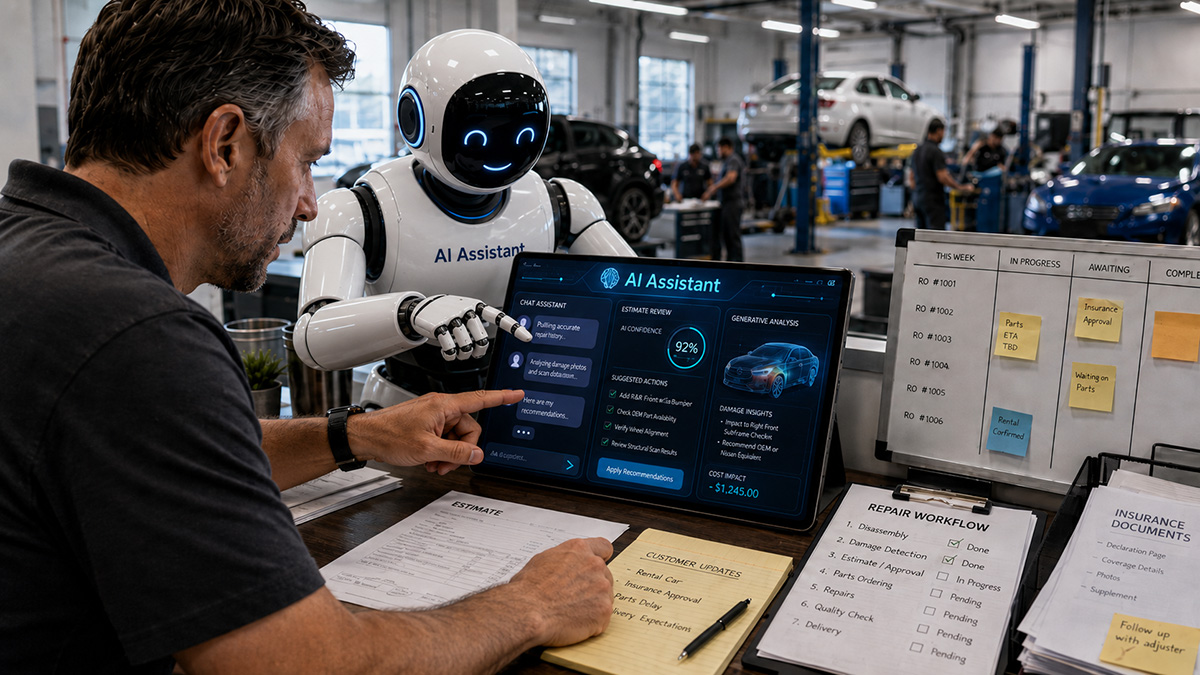
AI is everywhere right now.
Collision centers are hearing about tools that can write emails, summarize documents, answer customer questions, analyze information, and automate office work. That creates pressure to move quickly because nobody wants to feel like competitors are getting ahead.
But the biggest AI mistake is not waiting too long.
It is buying the tool before identifying the problem.
A new AI platform does not automatically make a collision center more efficient. It only creates value when it solves a real operational problem, produces accurate results, protects sensitive information, and fits the way the shop already works.
Start With the Shop Problem, Not the AI Tool
Most businesses have purchased software they later regretted.
Maybe the system promised to streamline operations but required too much manual work. Maybe employees never fully adopted it. Maybe it duplicated something the business already had or solved a problem that was never especially important.
AI can create the same situation faster because the promises are bigger and the pressure is stronger.
A collision center may see an impressive demonstration and assume the tool will improve customer communication, help estimators, reduce administrative work, or make employees more productive. But a polished demonstration is not the same as a useful business outcome.
Before evaluating any AI product, identify the specific frustration you want to remove.
Is the front office spending too much time rewriting similar customer updates? Are managers struggling to find information scattered across email, shared folders, and different locations? Are employees manually summarizing meetings, procedures, or vendor conversations?
Once the problem is clear, the value of the tool becomes much easier to judge.
AI Accuracy Matters More Than AI Speed
AI can produce information quickly, but that does not mean the information is always correct.
An AI-generated answer may sound confident while misunderstanding the source material, leaving out an important detail, or inventing information that was never provided.
Inside a collision center, those mistakes can matter. A customer update could describe the wrong repair status. A summary could omit an insurer requirement. A drafted email could promise a timeline the shop never approved.
AI should help employees work more efficiently, not make decisions on their behalf without review.
For any customer-facing, financial, insurance-related, safety-related, or repair-related information, a qualified employee should verify the result before it is used.
The goal is not simply to generate content faster.
It is to produce accurate work with less unnecessary effort.
Where AI Can Help a Collision Center
The best early AI projects are often not dramatic. They remove small, repetitive frustrations that happen every day.
AI can help draft routine customer emails that an employee then reviews and personalizes. It can summarize meetings, organize long vendor conversations, turn rough notes into clearer procedures, or help employees find information in approved company documents.
It may also help managers create first drafts of job descriptions, training materials, checklists, or internal announcements.
These uses do not replace employee judgment. They reduce the time spent staring at a blank screen, rewriting similar information, or sorting through material manually.
That is where AI often creates the most practical value: making ordinary work easier while keeping a person responsible for the final result.
Be Careful With Customer and Business Information
Collision centers handle more sensitive information than many owners realize.
Emails and documents may include customer names, addresses, phone numbers, vehicle information, insurance details, estimates, photos, payment information, employee records, and internal financial data.
Employees should not paste that information into a public AI tool simply because the tool is easy to access.
Before approving an AI platform, the business should understand what happens to the information entered into it. Is the data retained? Can it be used to train the provider’s models? Who can access it? Can the company control employee accounts? Can access be removed when an employee leaves?
A free consumer account and a properly configured business platform are not necessarily the same thing.
Without clear rules, employees may already be experimenting with AI using company information, even if leadership has never formally approved it.
Do Not Create Another Disconnected System
Growing collision centers already depend on many technology providers.
There may be separate systems for estimating, shop management, accounting, email, phones, insurance communication, cameras, file storage, and customer updates.
Adding another standalone tool can create more complexity instead of less. Employees may need another password, information may be copied into another platform, and managers may have no visibility into how the tool is being used.
A useful AI tool should fit into the business’s existing workflow rather than becoming another application that nobody fully owns.
For multi-location collision centers, consistency matters even more. If each shop uses different AI tools or follows different rules, the company may end up with uneven results, duplicated costs, and greater security risk.
Ask Employees Where Time Is Being Lost
The people doing the work often know where the best opportunities are.
Ask estimators, customer service representatives, managers, accounting staff, and administrative employees which tasks take longer than they should. Look for work that is repeated frequently, requires the same information to be rewritten, or forces employees to search across several systems.
Then choose one problem that is low-risk, measurable, and easy to review.
A collision center might test whether AI can reduce the time needed to prepare internal meeting summaries or draft routine customer communication.
Measure the time saved. Check the accuracy. Ask employees whether the tool genuinely improved the process. Confirm that sensitive information was handled properly.
A small controlled test will tell you more than a long list of promised features.
AI Still Needs Ownership
Buying an AI subscription is not an AI strategy.
Someone needs to decide which tools are approved, how employees may use them, what information must never be entered, and which outputs require human review.
Someone also needs to manage accounts, remove access when employees leave, review costs, and determine whether the tool is still delivering value.
Without ownership, AI adoption can spread informally. One employee uses a free chatbot. Another subscribes to a different platform. A manager creates a workflow nobody else understands.
Soon the business is paying for several tools while leadership has little visibility into where company information is going.
This is the same growth problem collision centers experience elsewhere in technology.
The business becomes too important and too complex for everyone to make technology decisions independently.
Use AI to Solve a Defined Problem
Tech Marvel helps growing collision centers in Morris County, Northern New Jersey, and throughout New Jersey evaluate technology based on how their shops actually operate.
We start by identifying where employees are losing time, where information is difficult to find, and where repetitive work is slowing the business down.
Then we help determine whether AI is the right solution, how it should be secured, what information employees may use, and where human review is required.
The objective is not to add AI because everyone is talking about it.
It is to use technology where it creates measurable value without introducing inaccurate information, exposing sensitive data, or adding another disconnected system.
Schedule Your Free IT Roadmap Meeting.
Let’s identify where AI can genuinely help your collision centers before you invest in the wrong tool.
Call 862-201-5710 or schedule your Free 20-Minute Dealership IT Review.