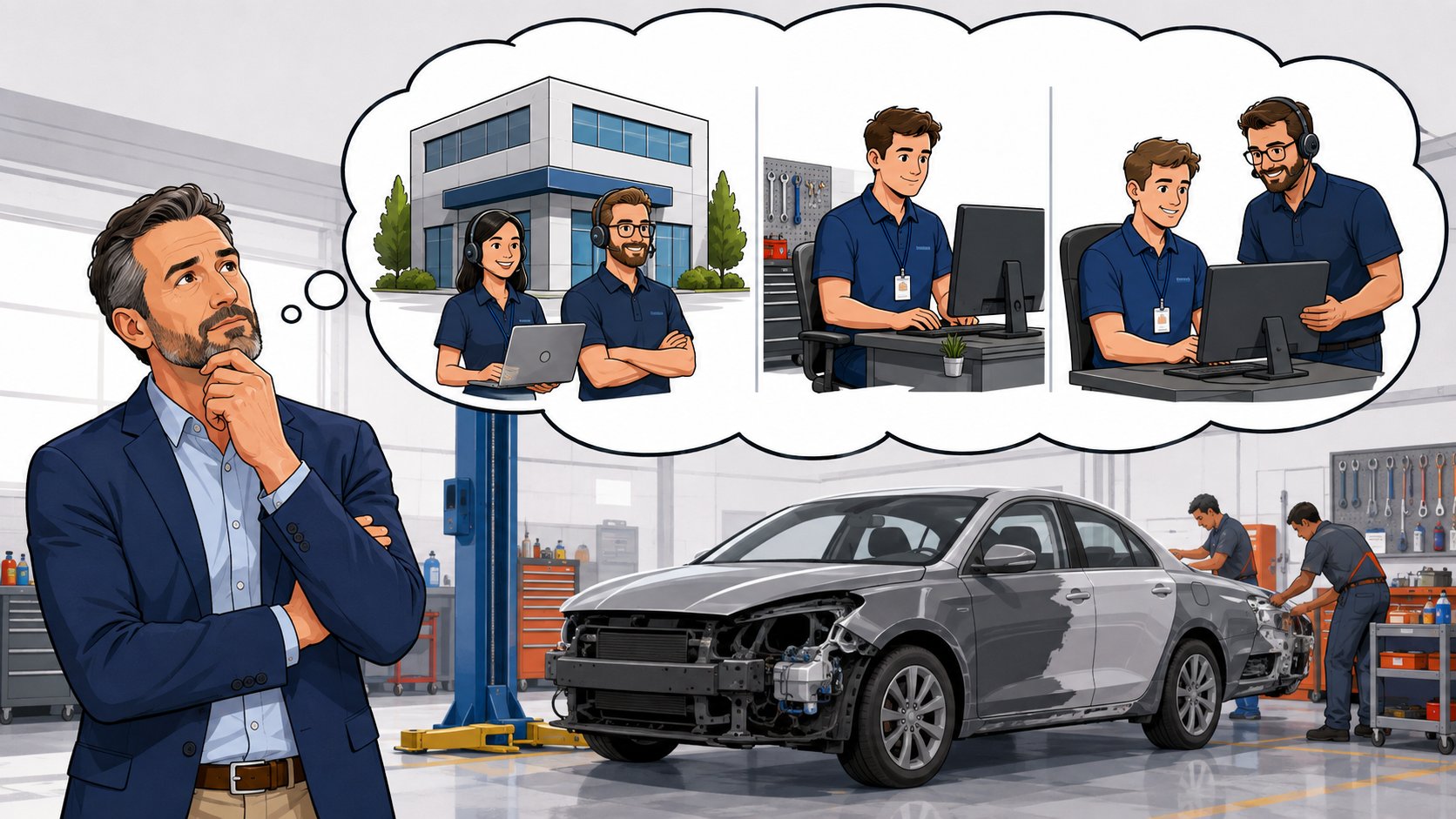
Growing collision centers generally manage technology in one of three ways: fully outsourced IT, co-managed IT, or an internal IT department. The right choice depends less on employee count or the number of locations and more on how much technology work requires dedicated attention inside the business.
A well-standardized multi-location collision center can often continue using an outsourced IT provider for many years. Internal IT becomes more valuable when the organization has enough ongoing projects, specialized systems, internal coordination, or technology leadership needs to justify one or more full-time employees.
In our experience working with growing businesses, the point where an internal IT role starts becoming useful usually isn't tied to opening a specific number of locations. It happens when technology projects, internal coordination, and strategic decisions begin requiring someone's attention almost every day.
The right IT model should reflect the needs of the business, not simply its size.
The Three Ways a Growing Collision Center Can Manage IT
As a collision center grows, its IT model usually falls into one of three categories.
| IT Model | How It Works | Usually Makes Sense When |
|---|---|---|
| Fully Outsourced IT | An outside IT provider manages support, cybersecurity, infrastructure, vendors, backups, and planning. | The business needs broad IT capabilities but does not need a full-time technology employee inside the company. |
| Co-Managed IT | An internal IT employee or leader works alongside an outside IT provider. | The business benefits from internal technology leadership but still needs additional expertise, support coverage, or specialized resources. |
| Internal IT Department | Employees inside the organization handle most or all technology responsibilities. | Technology work is substantial enough to justify multiple dedicated IT roles and ongoing internal management. |
None of these models is automatically better than the others.
The best fit depends on the amount of technology work your business generates, how specialized that work is, and which responsibilities benefit from having someone inside the organization.
1. When Fully Outsourced IT Still Makes Sense
Many growing collision centers can continue outsourcing their IT even as they add locations.
That's especially true when the technology environment is standardized.
If every location uses the same core computers, networking equipment, security policies, Microsoft 365 environment, backup strategy, and support process, adding another location doesn't necessarily create a completely new IT environment.
It expands an environment that is already being managed consistently.
A strong outsourced IT model may continue working well when:
- Most employee support can be handled remotely.
- Onsite work is occasional rather than constant.
- Locations follow consistent technology standards.
- The provider can support additional shops without response times suffering.
- Cybersecurity, backups, monitoring, and Microsoft 365 are centrally managed.
- The provider handles technology vendors on behalf of the business.
- Strategic planning and budgeting are already part of the relationship.
Location count by itself is a poor measure of IT complexity.
A ten-location collision center group with standardized technology can sometimes be easier to support than a two-location company where every shop operates differently.
The more consistent the environment becomes, the easier it is for an outsourced provider to scale support as the organization grows.
Growth does not have to increase technology complexity at the same rate.
2. When an Internal IT Employee Starts to Make Sense
Internal IT becomes more valuable when there is enough work that genuinely benefits from having someone inside the organization focused on technology every day.
That is different from simply having a lot of employees.
An internal IT employee may make sense when the business has frequent technology projects that require coordination across departments, locations, vendors, and leadership.
There may also be highly specialized systems that require deep knowledge of the company's internal processes.
Internal IT can make sense when:
- Technology projects are happening continuously.
- Leadership needs someone involved in daily operational planning.
- The company has highly customized or proprietary systems.
- Employees require frequent hands-on onsite support.
- Technology decisions regularly involve multiple departments.
- Someone needs to coordinate internal priorities with outside vendors.
- The business has enough technology work to keep a dedicated employee productive.
The important distinction is whether there is a genuine full-time internal role to fill.
Hiring an IT employee simply because the company reached a certain size may create a role that spends part of its time on strategic work and the rest waiting for technical issues to occur.
A well-defined internal position should have clear ownership and enough ongoing responsibility to justify the investment.
3. One Internal IT Employee Is Not the Same as an IT Department
Hiring one internal IT person can solve certain problems, but it also creates limitations.
One employee may know your business extremely well and provide excellent onsite support, but no single person can realistically specialize in every area of modern business technology.
They may be strong in networking but less experienced with cybersecurity.
They may understand Microsoft 365 but have limited experience with disaster recovery.
They may be excellent at employee support but have little time left for strategic planning.
There is also the practical issue of coverage.
Employees take vacations. They get sick. They attend training. They work on large projects that take them away from day-to-day support.
For many growing businesses, this is where co-managed IT becomes useful.
4. When Co-Managed IT Is the Better Fit
For many larger organizations, the answer isn't choosing between internal IT and an outsourced provider.
It's using both.
In a co-managed IT model, the internal employee or technology leader focuses on the areas where being part of the organization provides the most value.
That may include:
- Understanding leadership priorities
- Coordinating internal projects
- Working with department managers
- Managing business-specific applications
- Helping define technology policy
- Supporting long-term strategy
The outsourced IT provider supplies additional capacity and specialized expertise.
That might include:
- Help desk support
- Cybersecurity
- Backup and disaster recovery
- Network management
- Microsoft 365
- Monitoring and maintenance
- Major technology projects
- After-hours support
- Vacation and sick coverage
This can give a collision center the advantages of internal technology leadership without requiring the business to hire specialists for every technical discipline.
The internal employee doesn't have to be the help desk technician, cybersecurity specialist, network engineer, cloud expert, backup administrator, and strategic planner at the same time.
Instead, the outside provider becomes an extension of the internal team.
For a large or rapidly growing collision center organization, this can be more practical than trying to build every technical capability internally.
5. When a Full Internal IT Department Makes Sense
A true internal IT department usually becomes practical when the organization has enough technology work to justify several dedicated roles.
At that stage, technology may be deeply integrated into operations, reporting, internal systems, business intelligence, application development, or other strategic initiatives.
The organization may need people dedicated to areas such as:
- User support
- Infrastructure
- Cybersecurity
- Business applications
- Data and reporting
- Technology projects
- Strategic planning
Even companies with substantial internal IT departments commonly continue using outside specialists.
Certain areas may require expertise that is difficult or expensive to maintain internally, particularly cybersecurity, large infrastructure projects, cloud environments, or around-the-clock monitoring.
As a business grows, the relationship with an MSP doesn't necessarily end.
It often changes.
A company may start with fully outsourced IT, later hire an internal technology leader, and eventually build a larger internal team while continuing to use outside specialists for specific functions.
6. Five Questions to Help You Choose the Right IT Model
Instead of choosing an IT model based on headcount or locations, consider five practical questions.
1. How Much Technology Work Happens Every Day?
Is there enough ongoing work to justify someone focusing on technology full time?
Or does most of the workload consist of employee support, maintenance, cybersecurity, vendor coordination, and periodic projects that an outside team can handle efficiently?
2. How Much Work Truly Requires Someone Onsite?
Some businesses need constant hands-on support.
Others can resolve the majority of issues remotely and schedule onsite work when necessary.
If constant physical presence isn't required, outsourcing may continue to work very well even as the organization becomes significantly larger.
3. How Specialized Is Your Technology?
Most collision centers rely on a combination of standard business technology, Microsoft 365, networks, cybersecurity tools, cloud services, and collision-repair applications.
If your organization develops highly customized systems or has unusual internal technology requirements, dedicated internal expertise may become more valuable.
4. Does Leadership Need a Dedicated Internal Technology Leader?
As organizations grow, technology decisions can become increasingly strategic.
Leadership may want someone internally involved in budgeting, acquisitions, operations, data strategy, and long-term planning.
That doesn't necessarily require building an entire IT department.
It may mean hiring one technology leader and using a co-managed IT provider to provide the technical depth behind that person.
5. Can Your Current IT Model Scale With the Business?
Consider what would happen if you:
- Added another location
- Hired another 25 employees
- Acquired an existing collision center
- Added new security requirements
- Introduced additional business applications
- Started several major technology projects at once
If your current model can absorb that growth without service deteriorating, there may be no reason to change it.
If it can't, the answer may be a stronger outsourced provider, an internal hire, or a co-managed model.
Example: How the IT Model Can Evolve as a Collision Center Grows
Consider a collision center organization that begins with two locations.
At first, a fully outsourced IT provider may handle everything: employee support, Microsoft 365, cybersecurity, backups, networks, vendors, and technology planning.
The business grows to five locations.
Because the technology is standardized, the outsourced provider can continue supporting the organization without requiring an internal IT hire.
Later, the company expands further and begins managing frequent acquisitions, software projects, reporting initiatives, and internal technology changes.
Leadership may eventually decide that having an internal technology manager would improve coordination and help keep those initiatives moving.
The MSP doesn't disappear.
The relationship becomes co-managed.
The internal technology manager owns business priorities and internal coordination, while the MSP continues providing technical support, cybersecurity, infrastructure management, monitoring, and specialized expertise.
The change happened because the nature and volume of the work changed, not because the company crossed an arbitrary location threshold.
Multi-Location Growth Does Not Automatically Mean Internal IT
Adding locations increases the importance of good technology management, but it doesn't automatically create the need for an internal IT department.
Standardization can actually make a growing organization easier to support.
When every location follows the same standards for computers, networks, Wi-Fi, cybersecurity, backups, user accounts, and support processes, the company can add scale without adding the same amount of complexity.
That allows leadership to continue focusing on production, employees, customers, and growth rather than building an internal IT organization simply because the company expanded geographically.
A capable outsourced provider should be able to grow with a well-managed multi-location organization.
What Should You Look for in an Outsourced or Co-Managed IT Partner?
Whether your IT is fully outsourced or co-managed, the provider should be capable of supporting the complexity of your organization.
That includes:
- Experience supporting multi-location businesses
- Consistent support across locations
- Proactive monitoring and maintenance
- Cybersecurity expertise
- Backup and disaster recovery
- Microsoft 365 management
- Vendor coordination
- Technology documentation
- Hardware lifecycle planning
- Strategic technology roadmaps
- Support for acquisitions and expansion
The provider should also be able to explain how its service model will scale as your business grows.
Opening another collision center should not automatically force you to find another IT provider.
A capable partner should already have a plan for supporting additional users, locations, vendors, and technology requirements.
Bottom Line
A growing collision center does not automatically need an internal IT department.
For many organizations, fully outsourced IT remains an effective model across multiple locations, particularly when technology is standardized and the provider has the capacity to support continued growth.
Internal IT becomes more valuable when the business has enough day-to-day technology work, specialized systems, internal coordination, or strategic initiatives to justify dedicated employees.
For larger organizations, co-managed IT provides another option: internal technology leadership combined with the broader expertise, support capacity, and specialized resources of an outside IT provider.
Ultimately, the decision comes down to where technology ownership creates the most value.
Some responsibilities benefit from having someone inside the organization every day. Others are often more efficiently handled by a specialized outside team.
The right balance can change as the business grows - and a good IT strategy should be flexible enough to change with it.