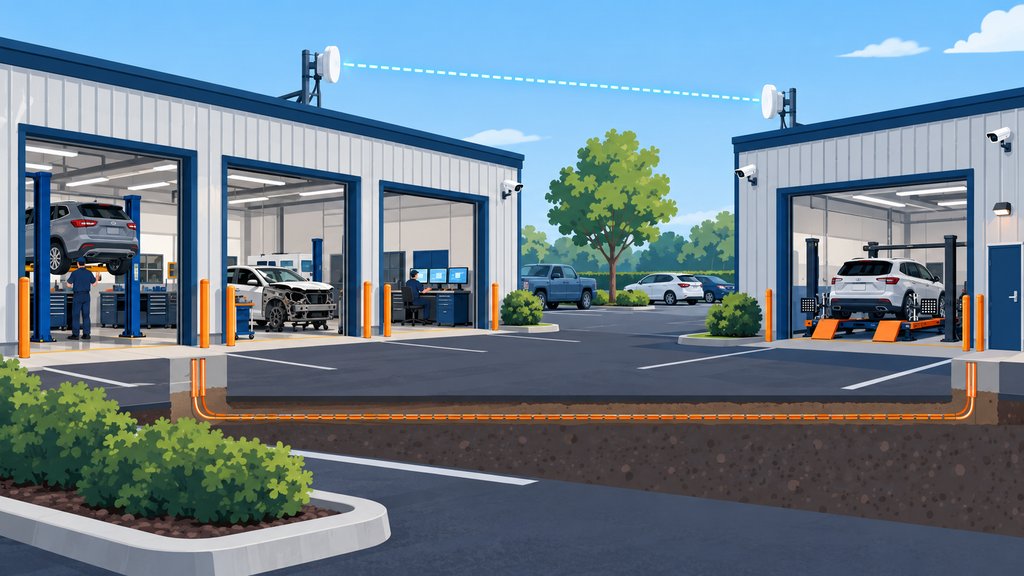
A second building changes the network question. The goal is no longer just to get a Wi-Fi signal across a parking lot. The business may need cameras to record continuously, computers to reach cloud and local systems, employees to use phones and printers, and alignment equipment to communicate reliably.
Those workflows have different requirements. A camera stream uses capacity differently from an estimator opening a workfile. Alignment equipment may depend on a vendor workstation, licensing, updates, or low-latency access. A connection that feels acceptable during a quick phone test may not be ready for permanent production.
Choose the second-building architecture after documenting distance, pathway options, line of sight, interference, bandwidth, reliability, security, power, cost, and the actual systems that must work there. Fiber, copper, point-to-point wireless, mesh, and a separate internet connection with VPN each fit different conditions.
Start With the Work Not the Technology
List every workflow in the second building and decide what happens when the link slows or fails. Count computers, cameras, phones, printers, access points, diagnostic or alignment systems, guest devices, and future growth. Record whether each system reaches the internet, the main building, a local server, a cloud platform, or a vendor.
Cameras may need steady upstream capacity and local recording paths. Computers may need identity, printing, file access, and shop applications. A production device may need a dedicated vendor connection or workstation. Those details determine capacity, segmentation, monitoring, and recovery needs.
When Does Fiber Make Sense?
Fiber is often attractive when a safe, permitted pathway can be built between the buildings and the business wants high capacity, electrical isolation, and a long-term physical link. The project may require trenching, conduit, permits, property access, termination, protected entry points, and coordination with electricians or low-voltage contractors.
Fiber is not automatically the least expensive or fastest option. The route can be more important than the straight-line distance. Pavement, drainage, utilities, property boundaries, building construction, and future site work can change the project.
When Is Copper Appropriate?
Copper may fit short, protected, standards-compliant pathways, but distance, surge exposure, grounding, building separation, and local code requirements need professional review. A loose outdoor cable between buildings is not a production design.
The decision should involve qualified cabling and electrical professionals. Tech Marvel can define network requirements and coordinate the project, but it should not make electrical or code claims outside its role.
When Does Point-to-Point Wireless Fit?
A point-to-point wireless bridge can connect two building networks when the sites have a suitable path, correct mounting, appropriate equipment, power, and a verified radio design. Cisco's guidance emphasizes site surveys, line of sight, antenna placement, and interference because the quality of the path matters as much as the presence of the radios.
A visual line of sight is helpful, but the radio path also needs surrounding clearance. Trees, trucks, metal buildings, rooftop equipment, seasonal foliage, and future construction can affect it. Mounting height, alignment, weather exposure, channel use, and local regulations belong in the design.
Is Mesh the Same as a Wireless Bridge?
Not exactly. A dedicated bridge is designed to connect network segments across a point-to-point or point-to-multipoint backhaul, while mesh usually extends connectivity through one or more wireless access points. Some platforms combine these functions, but the traffic path and shared-radio capacity still need to be understood.
Mesh can be useful where cabling is impractical or where several nodes need coverage. It can also introduce extra hops, shared capacity, and placement sensitivity. The word 'mesh' does not guarantee that the second building has a production-quality connection.
When Does a Separate Internet Circuit and VPN Fit?
A separate internet service with a site-to-site VPN may fit when the second building operates more like another location than an extension of the first building. Each building has its own carrier connection, firewall, and local network, while the VPN provides controlled access between approved resources.
That design adds recurring carrier cost and makes inter-building performance depend on both internet services and the VPN path. It may provide useful separation, but it is not automatically redundant. Shared carrier routes, common power, firewall configuration, and application behavior still matter.
A Real Second Building Example
At one collision business, a second building about 150 feet away needed permanent connectivity for computers, cameras, and vehicle-alignment equipment. A mesh connection already existed, but the access point was not positioned to direct the signal correctly between the buildings.
Tech Marvel reviewed the design, rebuilt how the mesh operated, and repositioned the access point. The redesigned link became the production connection for those systems. We do not claim a precise distance beyond approximately 150 feet, measured throughput, redundancy, or that the same approach fits another property.
How Should the Connection Be Tested?
Test the link under the production load and conditions it must carry, then document the result. A useful acceptance test includes:
- Throughput and latency in both directions at normal and busy periods.
- Packet loss, errors, radio quality, or physical-link health over time rather than one speed test.
- Real camera viewing and recording, workstation access, printing, voice, Wi-Fi, alignment-system connectivity, and vendor workflows.
- Power loss and restart behavior in both buildings, including switches, radios, firewalls, recording equipment, and UPS coverage.
- Security segmentation so cameras, guest devices, production systems, and management access do not share more access than necessary.
- Monitoring, alert routing, configuration backups, labels, mounting records, and a diagram showing the inter-building dependency.
How Do You Choose Among the Options?
Compare the designs against the same business requirements rather than picking the technology first. Ask what capacity is needed now and later, which pathway is available, whether line of sight can be protected, what outage the shop can tolerate, who maintains each component, and what the complete installed and recurring cost will be.
For managed IT services for collision centers, Tech Marvel can assess network requirements, design and support covered connectivity, coordinate cabling, carrier, and equipment vendors, secure the connection, and monitor agreed components. Vehicle alignment procedures and proprietary equipment support remain with qualified automotive and equipment specialists.
If a second building is becoming part of production, schedule a Free 20 Minute Automotive IT Risk Review. If you are not ready to schedule, write down every device and workflow the building needs, the route between buildings, the acceptable outage, and the person who owns the design decision.
Frequently Asked Questions
Is fiber always better than wireless between buildings?
No. Fiber can offer excellent capacity and electrical isolation, but pathway construction may be expensive or impractical. A properly designed wireless bridge can be effective where the path is suitable. Compare requirements, risks, and total project conditions.
Can ordinary Wi-Fi access points connect two buildings?
They may create a link in some designs, but production connectivity should use equipment and configuration intended for the path, mounting, weather, capacity, and management requirements. A quick signal test is not an acceptance test.
Should cameras share the same network as alignment equipment?
Not automatically. Segmentation can reduce unnecessary access and contain faults, but the VLAN and firewall design must match device requirements, vendor support, recording paths, and management needs.
Does a second-building link need backup connectivity?
That depends on the business impact of a failure and the cost of an alternate path. Document what work stops, how long the shop can tolerate it, and whether a diverse backup path is technically and financially justified.