Collision center leaders spend plenty of time talking about production, parts, staffing, supplements, insurance relationships and getting vehicles delivered on time.
Technology usually gets attention only when something goes wrong.
CCC slows down. The internet drops. An estimator can't connect. The phones stop working. Someone calls the software vendor, the software vendor blames the network, and suddenly a manager is spending half an hour trying to figure out who actually owns the problem.
Then it gets fixed, everyone moves on, and nobody talks about it again until the next issue.
For a growing collision center, that gets expensive.
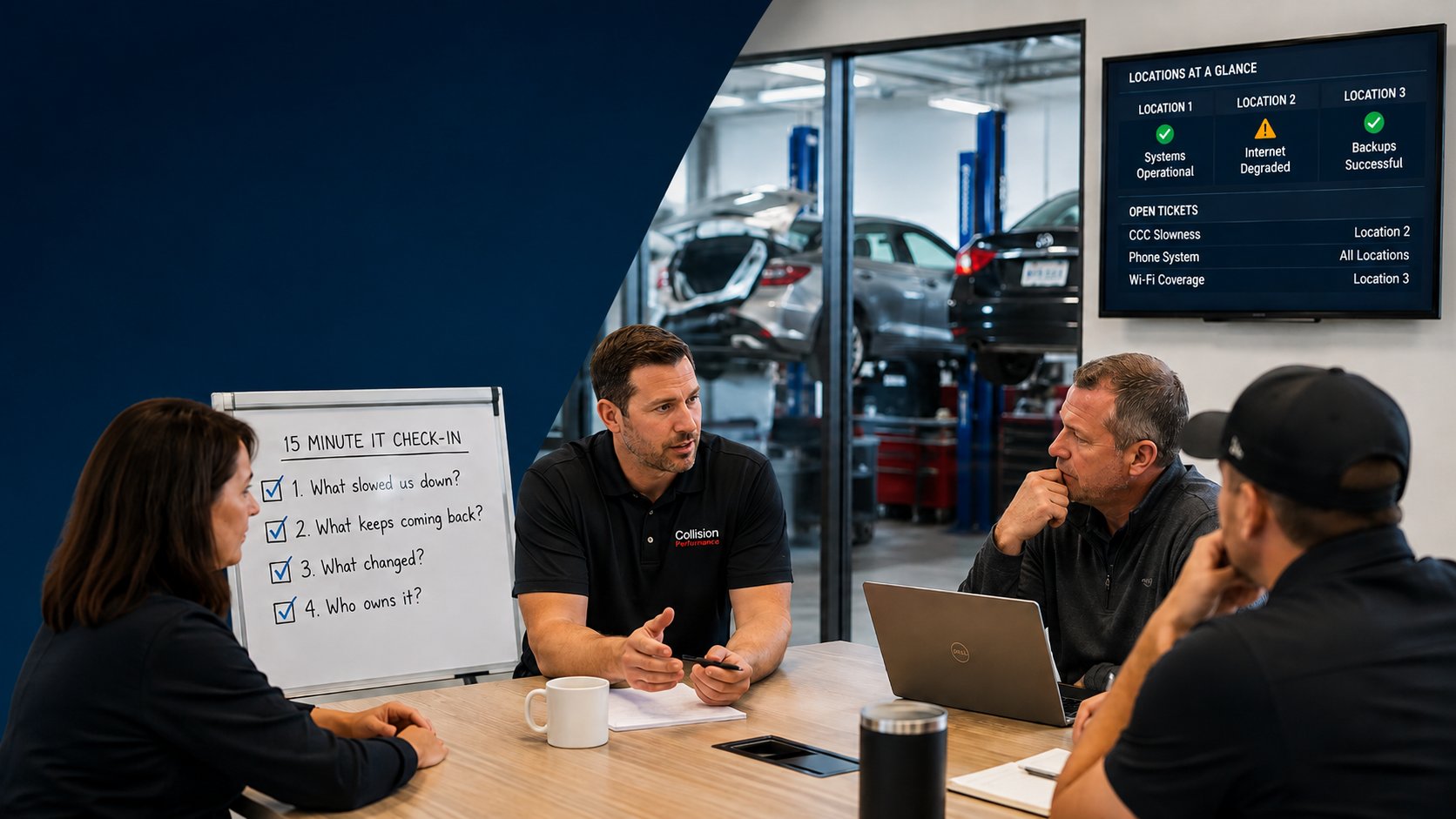
You don't need another long meeting to fix it. A simple 15-minute technology check-in once a month can help uncover recurring problems before they become part of the way your shop operates.
And no, your leadership team does not need to talk about servers, firewalls or software patches.
Just ask four questions.
1. What Slowed Us Down This Month?
Start with the stuff your employees actually noticed.
Did CCC or Mitchell run slowly? Did someone have trouble with an insurance portal? Was Wi-Fi unreliable in part of the shop? Did an estimator lose time waiting for a computer, printer or phone issue to get resolved?
One five-minute problem doesn't sound like much.
But when several employees are losing five or ten minutes at a time, multiple times a week, those little interruptions start adding up.
You don't need to know why the problem happened during the meeting.
You just need to know that it happened.
For collision centers that rely heavily on estimating platforms, insurance communication, customer updates and shop management systems, small technology problems can quickly turn into production problems.
2. What Problem Keeps Coming Back?
Every shop has the occasional strange computer issue.
That's normal.
What deserves attention is the problem everyone has learned to work around.
Maybe one location has unreliable internet. Maybe a particular workstation has been "fixed" three times. Maybe employees keep losing access to the same system. Or maybe every time the phones act up, two or three vendors get involved and nobody seems sure whose problem it is.
Those are the issues worth discussing.
A recurring technology problem usually means the underlying cause hasn't actually been fixed.
And once your collision center has multiple locations, recurring problems can become even harder to spot because each location may be dealing with something different.
The goal is not perfection.
It's making sure the same problem isn't quietly costing your team time every week.
3. What Changed?
This is probably the easiest question to overlook.
Collision centers change constantly.
You hire someone. Someone leaves. A vendor installs new software. You add a workstation. You replace a printer. You change an insurance relationship. A new estimating tool gets introduced. Someone starts working remotely. Another location gets added.
None of that sounds like a major IT event.
But pile enough small changes on top of each other and suddenly nobody is quite sure how everything is connected.
That's where things get messy.
A quick monthly check gives you a chance to make sure new employees were set up correctly, former employees had access removed, new equipment was added properly and vendors didn't make changes that create problems somewhere else.
For multi-location collision centers, this is especially important.
The more consistent your technology is from location to location, the easier it is to support employees, train new people and solve problems when something goes wrong.
4. Who Owns It?
This is the question that matters most.
If your phone vendor says it's an internet problem and your internet provider says it's a network problem, who keeps working the issue until it's fixed?
If the backup stops running, who notices?
If an employee leaves, who makes sure their email, shared files and other accounts are shut down?
If Wi-Fi at one location has been unreliable for two months, who is responsible for actually fixing it?
Too often, the answer is the owner or general manager.
Not because they should be handling IT, but because nobody else clearly owns the outcome.
That's where a good IT partner should make life easier.
You shouldn't have to figure out which vendor to call, translate technical answers between companies or keep following up until someone finally takes responsibility.
One person should own the issue and see it through.
Keep It to 15 Minutes
This meeting should not become a technical deep dive.
You're not trying to solve everything while everyone is sitting around the table.
You're simply asking:
- What slowed us down?
- What keeps happening?
- What changed?
- Who owns the next step?
Anything that needs more investigation can happen afterward.
That's it.
Fifteen minutes.
The value is in catching patterns before everyone starts accepting them as normal.
Growing Collision Centers Need a Different Approach to IT
When your business was smaller, informal IT support may have worked perfectly well.
Maybe the owner handled a few things. Maybe someone in the front office knew the passwords. Maybe you had a local computer person you called when something broke.
There's nothing wrong with that.
But a collision center with multiple locations, dozens of employees and systems like CCC, Mitchell, Audatex, insurance portals, accounting software, phones, Wi-Fi and security cameras is a very different business.
At some point, technology stops being a collection of computers and starts becoming part of the operation.
That's usually when the bigger question becomes:
Who is making sure all of this works together?
That's the shift growing collision centers eventually have to make.
Not because their old IT support was bad.
Because the business got bigger.
Your Technology Should Make Running the Shop Easier
You have enough to manage already.
Production. Employees. Customers. Insurance companies. Parts. Vendors. Multiple locations.
You shouldn't also be the person everyone calls when the internet goes down or an estimating system stops working.
A 15-minute monthly technology meeting won't eliminate every problem.
But it will make recurring problems harder to ignore, give your leadership team better visibility and force one important question to get answered:
Who owns this?
Tech Marvel provides managed IT services for collision centers throughout New Jersey, helping growing shops keep their systems working, reduce downtime and give leadership one accountable technology partner across every location.
Schedule Your Free IT Roadmap Meeting
We'll walk through your locations, systems, vendors and recurring technology problems and show you where IT may be slowing the business down - and what can be done about it.