By Ron Conti, Owner and Founder of Tech Marvel
Monday morning, your busiest shop. CCC ONE keeps saying it can't connect, even though web pages load fine. The estimators call the software company, which says the problem is on your network. Your general manager calls the internet provider, which runs a test and says the line looks clean. Your IT person thinks it's a software update. By eleven o'clock you've got three opinions, two estimators writing nothing, and a supplement that still hasn't gone to the insurer.
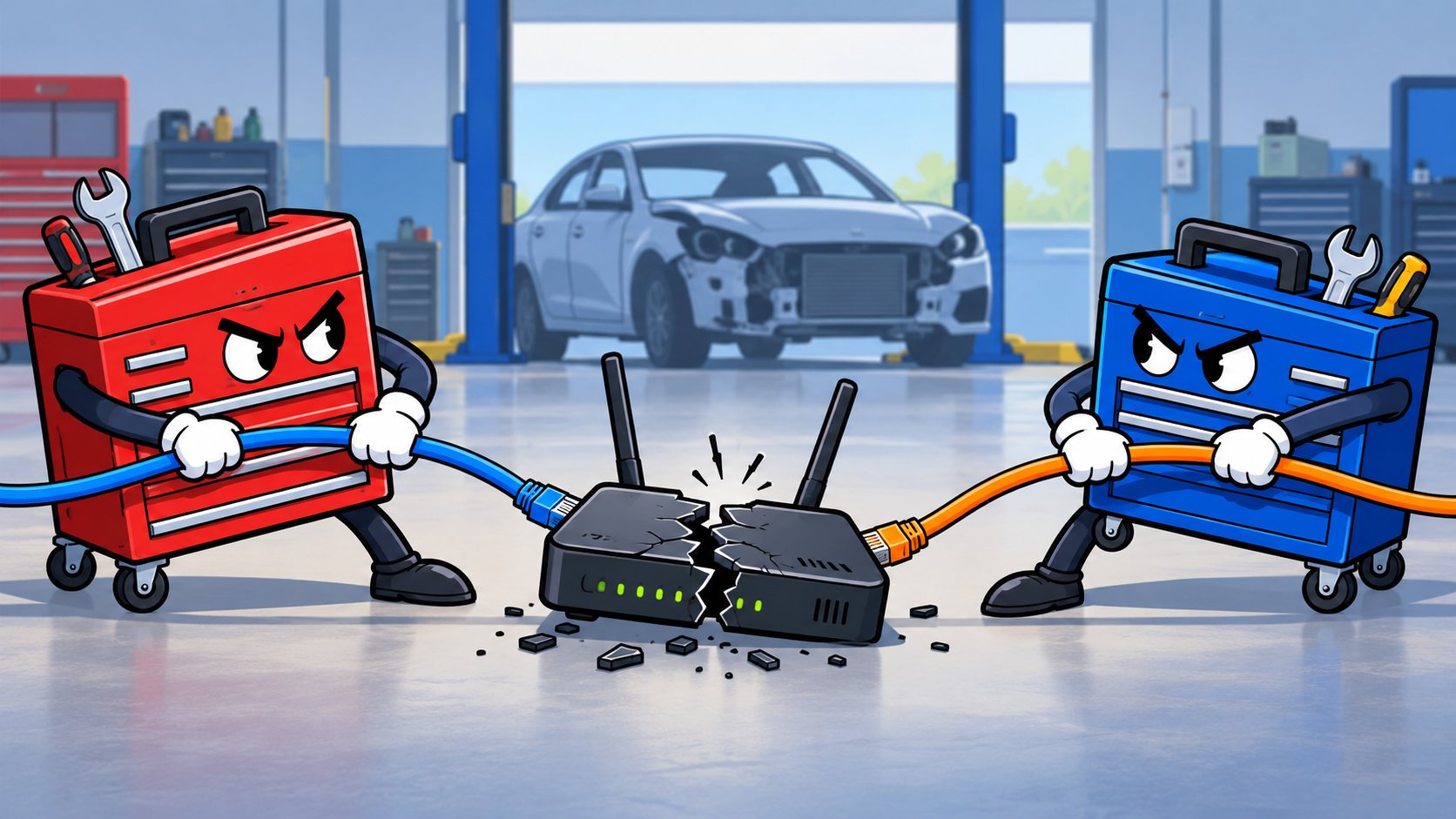
When vendors blame each other, the problem belongs to whoever is responsible for the whole technology environment, and at most growing collision centers nobody has that job. Each vendor can only test its own piece, so each one reports its piece is fine. The fix is one accountable partner who checks the pieces in between, brings the right vendor in with evidence, and stays on the problem until the shop is working again.
The software company, the internet provider, and your IT person are each telling you the truth about what they can see. None of them can see the whole shop.
Why Collision Center Vendors Blame Each Other
Vendors blame each other because each one can test only the part of your shop's technology it controls. The estimating software company can see its servers and its application. The internet provider can see the line up to the equipment it installed. Your phone vendor can see the phone system. Nobody on that list looks at the firewall, the switches, the Wi-Fi, the workstation, the user account, or the cabling between them, and that's where a lot of collision center problems actually live.
So everyone runs their test, everyone passes, and the problem keeps happening. Meanwhile the cost lands on production. An estimator who can't open a workfile can't write an estimate or send a supplement, parts orders wait, and cars sit in the lot a day longer than they should. Your manager spends the morning on hold. And if the same thing happens at a second location a few weeks later, you'll start the whole loop over, because nothing from the first round was written down. Somewhere along the way the calls start coming to you, and you feel frustrated because you're still the one everyone turns to when systems fail, even though your business has grown beyond that.
What Each Vendor Owns, and What Falls Between Them
Every vendor in a collision center owns a defined piece, and the problems that cause the most finger-pointing sit between those pieces. Written out, the list looks like this.
- Your estimating platform (CCC, Mitchell, or Audatex/Solera) owns its application, its cloud services, and its account settings.
- Your internet provider owns the circuit and the equipment it installed at the edge of the building.
- Your phone vendor owns the phone system and, often, the desk phones.
- Your copier or printer company owns the printers it leases.
- Camera, accounting, and payment vendors own their own platforms and devices.
What's left over is everything that connects them: the firewall and router settings, the network switches, Wi-Fi, cabling, the workstations themselves, Microsoft 365, user accounts and passwords, and the documentation that says how it all fits together. That middle layer is where someone has to take ownership. CISA's Cyber Essentials guidance recommends that businesses keep an inventory of who connects to their network, including vendors, and that list is a good place to start drawing those lines.
Three Real Problems Nobody Owned
Real cases show that finger-pointing usually ends when someone tests the pieces between the vendors. Each of these started with a vendor saying its piece was fine.
At one business we worked with, the internet kept dropping for years and took the phones, the camera viewing, and every computer down with it. We replaced a cheap network device sitting next to the provider's equipment, had the provider check the line, and tested the router. The drops kept coming back. Eventually we found a cable under too much strain that was failing. The connector looked fine, but it had to be cut off and replaced, and everything worked after that. The provider had been right all along: its line was fine.
At a collision center we worked with, someone thought the internet was slow and called the internet provider directly. The provider swapped out its equipment, and that knocked out the network setup behind it. We went in and put the network back together. Whoever made the call meant well. They didn't know how the pieces connected, and no one person had the whole picture.
And something we've seen at more than one collision center: when shops moved to internet-based phones, the phone company ran each computer's network connection through the desk phone to avoid new wiring. The desk phones could only pass along 100 megabits, which is plenty for a call and too slow for today's computers. Neither the shop nor the phone company noticed. We added a network device that gave the phones and computers their own connections, and the computers went back to full gigabit speed.
A Simple Handoff Rule for Your Shops
One rule ends most finger-pointing: a single owner takes every report, proves where the problem is, and brings in the vendor with evidence. You can start using it this week, whoever handles your IT today.
- Pick one person or partner that every employee and every location calls first, no matter what broke.
- Keep a current list of vendors for each shop, with support numbers, account numbers, and who's authorized to call.
- Test your own pieces before calling anyone: the workstation, the account, the network, and the Wi-Fi.
- Open the vendor ticket with specifics, such as which shop, which workstation, what error, and what's already been ruled out.
- Stay on the ticket until the shop is working, then write down what fixed it.
That fourth step changes the conversation. A vendor that hears "it's broken" will run its standard test and tell you it passed. A vendor that hears "every workstation at our second shop loses CCC at the same time, the web still works, and here's what we've checked" usually starts looking in the right place. For a closer look at that exact situation, see what's failing when CCC ONE says there's no internet but the web works.
What One Accountable Partner Changes
One accountable partner gives your shops a single call for every technology problem and someone who stays on it until the cars are moving again. You didn't get into the collision repair business to manage technology. You got into it to build a great company, serve your customers, and create opportunities for your employees. Growing collision centers deserve professional IT that keeps the business running as reliably as you repair your customers' vehicles.
Tech Marvel helps growing New Jersey collision centers replace informal IT support with one accountable technology partner for every location. We don't develop or support estimating software as a partner, and CCC, Mitchell, and Audatex remain responsible for their own products. We manage everything around them, monitor your systems around the clock, keep documentation updated each quarter, and coordinate the vendors when a problem crosses into their territory. If repeat problems are a theme at your shops, why your collision center keeps having technology problems is a useful next read, and the collision center cybersecurity responsibility matrix applies the same thinking to security.
Frequently Asked Questions
Will our software vendor work with an outside IT company?
In our experience, yes. Vendors generally move faster when the person on the call can describe the network, rule out the workstation, and test a fix on the spot. You'll usually need to authorize your IT partner as a contact on your account first.
Does Tech Marvel support CCC ONE?
We support the technology CCC ONE runs on, including workstations, network, Wi-Fi, and accounts, and we coordinate with CCC when a problem crosses over. CCC supports its own application.
What if the problem really is the vendor's?
Then the job is to get it in front of the vendor with enough detail that it gets fixed, and to keep following up so your manager doesn't have to.
Your Next Step
Walk us through your shops, get a practical IT roadmap, and then let us take IT off your plate. In about 20 minutes we'll go over which vendors touch each location and where problems tend to stall, and you'll leave with a one-page plan of your top risks, 30-day quick wins, and priorities for the next 6 to 12 months.
We work out of Morris County and support collision centers throughout Northern New Jersey and the rest of the state. Most vendor problems get worked remotely; when one needs a person at the shop, we go. Learn more about Tech Marvel's collision center IT services.
Schedule Your Free IT Roadmap Meeting
Not ready for a call? Get the free guide, 10 Signs You've Outgrown 'The IT Guy'
Confidently grow your collision centers, serve your customers, and lead your team knowing every location is protected, productive, and supported by one accountable IT partner.