By Ron Conti, Owner and Founder of Tech Marvel
You're setting next year's budget, and the line for technology keeps growing. Your controller asks the obvious question: "Wouldn't it be cheaper to just hire someone?" For a collision center with three shops and a few dozen people in the office, estimating, and management, it's a fair question, and the answer depends on what you're comparing.
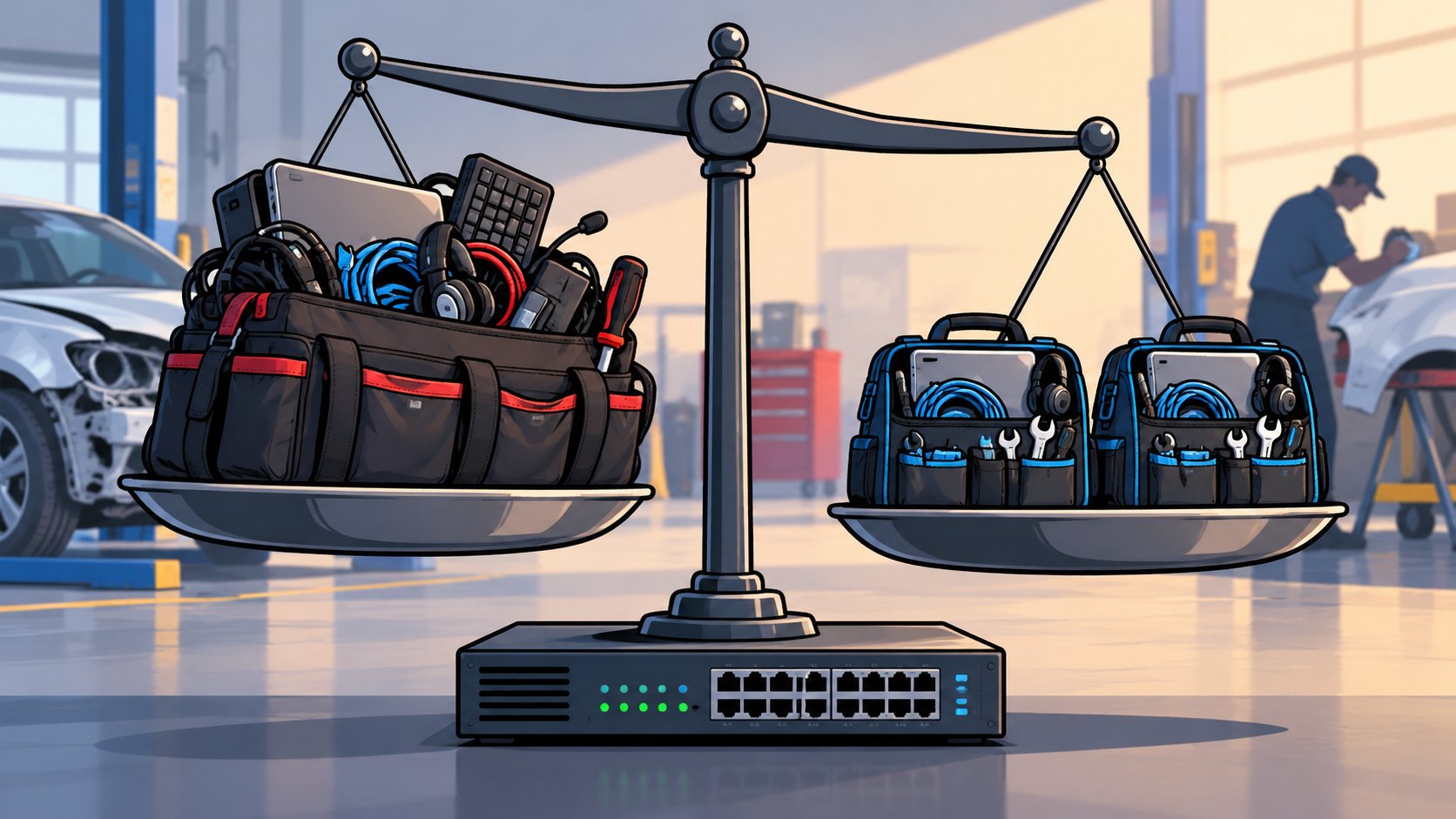
For a collision center with about 30 to 60 office, estimating, and management users, managed IT usually costs about the same as one full-time IT support employee in New Jersey, and it covers more than one person can. Above roughly 80 users, managed IT costs more than a single salary, but by then one person cannot realistically support every location alone, so the fair comparison is managed IT versus a small internal team or a hybrid of the two.
The dollar totals are half the comparison. What each option actually covers is the other half, and it can change the answer just as much.
What One In-House IT Person Costs in New Jersey
A full-time IT support employee in New Jersey earns about $71,000 a year in wages, and a network and systems administrator earns about $119,000. According to Bureau of Labor Statistics wage data for New Jersey (May 2025), the annual mean wage was $70,970 for computer user support specialists and $119,390 for network and computer systems administrators.
Those are wages only. On top of them you'd pay payroll taxes and benefits, plus the tools the job needs: monitoring software, security tools, a backup service, a password manager, and training to keep up. You'd also have to recruit and manage the person, which most collision center owners aren't set up to do for a technical role.
There's a skill question too. A support specialist is usually strongest at helping users with computers, printers, and accounts. A systems administrator handles firewalls, servers, and security. Most growing collision centers need some of both, and one hire rarely covers both well.
What Managed IT Costs for a Collision Center
Managed IT for a growing collision center typically runs $125 to $200 per user per month. That range applies to the office, estimating, administrative, and management staff who have their own computer, email, or accounts. Technicians who only use a shared shop login usually don't count as users, while technicians with their own email or tablet usually do.
At three common sizes, that works out to:
- 30 users: about $3,750 to $6,000 a month, or $45,000 to $72,000 a year
- 50 users: about $6,250 to $10,000 a month, or $75,000 to $120,000 a year
- 100 users: about $12,500 to $20,000 a month, or $150,000 to $240,000 a year
Where you land in that range depends on how many locations you have, the age of your equipment, your security requirements, and how standardized your shops already are. Hardware, software subscriptions such as your estimating platform, and one-time projects are usually quoted separately. For more detail, see how much IT should cost for a collision center with 20 to 100 employees.
In-House IT vs. Managed IT Cost: Comparing Like for Like
A fair comparison of in-house IT vs. managed IT cost counts coverage, tools, and backup for the person, along with the salary. One employee works about 40 hours a week, takes vacation, gets sick, and can be at one shop at a time. When the internet goes down at your farthest location while that person is installing a computer at another, somebody waits.
Questions worth putting next to each number:
- Who covers the shops when the IT person is on vacation or leaves for another job?
- Who watches the systems at night and on weekends?
- Who owns cybersecurity, backups, and restore testing, and who checks that work?
- Who handles vendor coordination when the estimating platform and the internet provider disagree?
- Where does the documentation live if that person walks out tomorrow?
That last one isn't hypothetical. At a nonprofit we worked with, the person who paid the bills left, and payment to the cloud backup company fell through the cracks. The backup account was deleted. When ransomware hit later, the backups were gone, and the organization lost years of work. One person holding a responsibility nobody else knew about cost far more than any salary. The collision center version is a domain, an insurance portal login, or a software subscription that only one person knows how to renew. When it lapses, email or estimating can stop at every shop.
The Costs Neither Number Shows
The biggest IT cost at most growing collision centers is time lost by people who are not in IT. It never shows up on an invoice, so it's easy to leave out of the comparison.
Think about what happens when CCC ONE won't connect at one shop for two hours. Two or three estimators can't write or send anything. The front office can't give customers an update. Parts orders wait, and the cars behind them sit a little longer, which shows up later in your cycle time. Then your general manager spends the morning calling vendors, and by lunch you've been pulled in too.
Add up a few of those mornings a month, across several locations, and the gap between a $70,000 salary and a $90,000 managed IT bill starts to look small. The reverse is also true: if your shops rarely have problems and your current setup is well documented, the cheapest option might be the one you already have. I'd rather you know which situation you're in before spending anything.
When an In-House Hire Makes Sense
An in-house IT hire makes sense when the business is large enough to keep that person busy with projects and needs someone on site every day. Groups that open or acquire shops often, run their own reporting and software projects, or have well over 100 users across many locations usually get there. Even then, many keep an outside partner for monitoring, security, backups, and coverage when the internal person is out.
That hybrid, often called co-managed IT, is common. Your internal person handles the day-to-day at the shops, and the partner covers the systems and coverage one person can't. Our article on when a growing collision center needs internal IT goes deeper on choosing between the models.
What to Do Before You Decide
Start by counting your real users and listing what IT work happens today, and who does it. Most owners find more of that work landing on managers, estimators, and themselves than they expected. Then write down the last few times something stopped work at a shop, who fixed it, and how long the shop waited. If your own name shows up on most of that list, you feel frustrated because you're still the one everyone turns to when systems fail, even though your business has grown beyond that. You didn't get into the collision repair business to manage technology. You got into it to build a great company, serve your customers, and create opportunities for your employees.
Next, put the options next to each other over three years, including replacement equipment and growth. Building a 3-year IT budget for a collision center lays out how.
Tech Marvel helps growing New Jersey collision centers replace informal IT support with one accountable technology partner for every location. Our clients get systems watched around the clock, a test restore every month, documentation brought up to date each quarter, and a quarterly roadmap meeting about what to fix and budget for next. Growing collision centers deserve professional IT that keeps the business running as reliably as you repair your customers' vehicles.
Frequently Asked Questions
Does the managed IT price include new computers?
Usually not. Hardware, software subscriptions, and one-time projects such as opening a new location are typically quoted separately. Ask any provider for a written list of what's included and what isn't.
Do technicians count as users?
It depends on how they work. Technicians who only use a shared shop login usually don't count. Technicians with their own email, accounts, or tablet usually do.
Can we keep our IT person and add a managed provider?
Yes. Many growing collision centers do exactly that, with the internal person handling day-to-day support and the partner covering monitoring, security, backups, and after-hours coverage.
Your Next Step
Bring your user count and what you spend on IT today. Walk us through your shops, get a practical IT roadmap, and then let us take IT off your plate. The conversation takes about 20 minutes, and the one-page plan you leave with covers where you stand, your top risks, 30-day quick wins, and priorities for the next 6 to 12 months, with a realistic picture of cost.
We're a Morris County company working with collision centers across Northern New Jersey and the rest of the state. Learn more about Tech Marvel's collision center IT services.
Schedule Your Free IT Roadmap Meeting
Not ready for a call? Get the free guide, 10 Signs You've Outgrown 'The IT Guy'
Confidently grow your collision centers, serve your customers, and lead your team knowing every location is protected, productive, and supported by one accountable IT partner.